
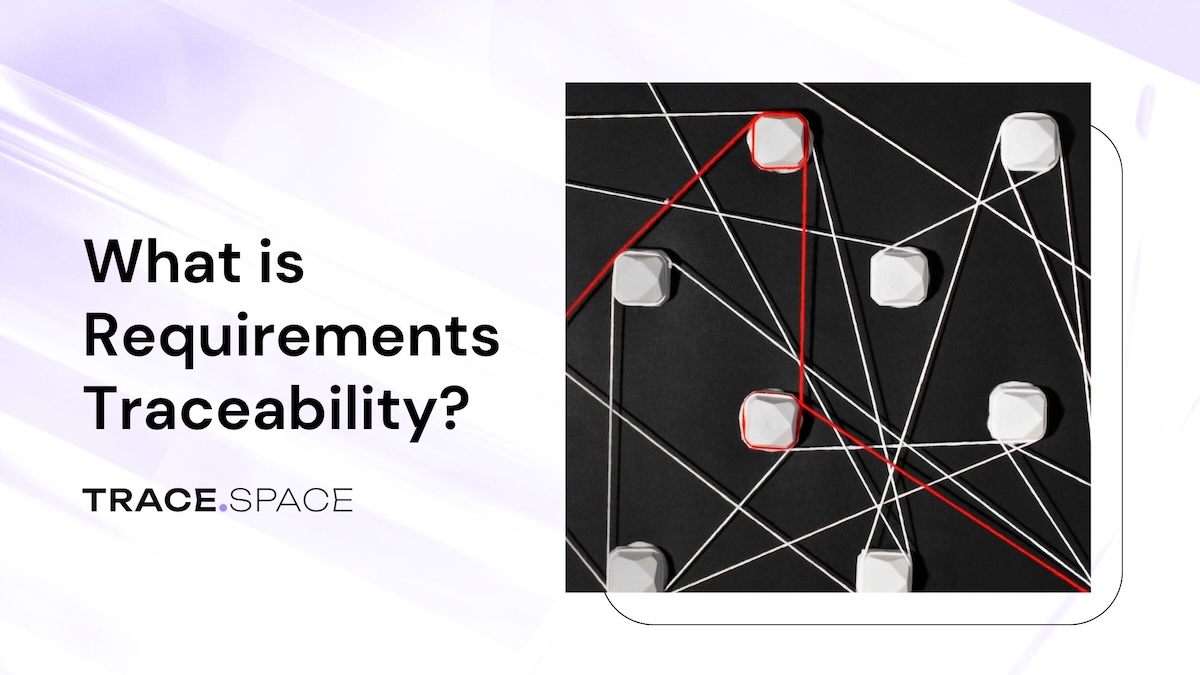
What is Requirements Traceability? From Definition to End-to-End Coverage
Engineering
/

Mikus Krams
/
Feb 4, 2026
If you build complex regulated products across aerospace, automotive, medical devices, or hardware manufacturing, every requirement your team writes must connect to a design decision, an implementation, and a verified test result. Requirements traceability is the practice that makes these connections visible and provable, tracking each requirement from its origin through development to final verification.
Two classification systems define how traceability links work. Direction-based traceability describes the flow through the development lifecycle: forward, backward, or bidirectional. Structure-based traceability describes where links connect: vertically across abstraction levels or horizontally across domains. The Requirements Traceability Matrix (RTM) is the primary artifact teams use to map and manage these relationships across the product lifecycle.
Below, you will find a working definition grounded in hardware and software examples, a breakdown of all five traceability types across both classification systems, the benefits and real-world challenges your team should expect, industry-specific compliance requirements across five major standards, and practical criteria for choosing the right tool.
Key takeaways
- Requirements traceability is the practice of linking every requirement to its origin, its implementation, and its verification evidence. The Requirements Traceability Matrix (RTM) is the primary artifact teams use to map and manage these relationships across the product lifecycle.
- Two classification systems define traceability links: direction-based (forward, backward, bidirectional) describes how links flow through the lifecycle, while structure-based (vertical, horizontal) describes where links connect across abstraction levels and engineering domains.
- Catching requirements issues late in the product lifecycle costs 40 to 110 times more than catching them early, according to INCOSE research. Separately, 70 to 80 percent of rework costs stem from ambiguity and contradictions in requirements (Jama Software, 2026).
- ISO 26262, DO-178C, ISO 13485, IEC 62304, and ASPICE all mandate requirements traceability for certification, though each standard defines the scope and depth differently. Products with embedded software often must satisfy multiple standards simultaneously, requiring parallel traceability chains that connect at system-to-software interface boundaries.
- Horizontal traceability across mechanical, electrical, and software domains is where multi-domain hardware products face the greatest coordination risk. A change in one domain must be immediately visible to the others, and fragmented tooling across PLM, Jira, CAD, and test management systems is the top practical barrier to maintaining those cross-domain links.
What is traceability in requirements management?
Requirements traceability is the ability to describe and follow the life of a requirement in both forward and backward directions, from its origins through development and specification to deployment and use. The concept was formally defined by Gotel and Finkelstein in 1994 and remains a foundational discipline in systems engineering, particularly for teams building safety-critical hardware and software products.
At its core, traceability answers three questions about every requirement in your system:
- Where did it come from? A customer need, a regulatory standard such as ISO 26262, or an internal engineering specification.
- Where did it go? Design specifications, CAD files, BOM components, prototypes, source code modules, and test plans.
- Has it been verified? Test reports, lab inspection results, simulation outputs, or regulatory approval documentation.
These three questions form the proof chain that connects stakeholder intent to a delivered, verified product. When any link in this chain breaks, requirements drift undetected and compliance gaps grow.
The primary artifact for managing this chain is the Requirements Traceability Matrix (RTM). A traceability matrix maps relationships between any two sets of engineering artifacts. Rows and columns can hold requirements, design elements, test cases, verification results, or any other artifact type that needs linking. The matrix format makes it possible to read intersections and spot gaps: an empty cell where a link should exist is an immediate signal that something is missing from the chain.
When a requirement changes, a well-maintained RTM shows exactly which designs, components, tests, and approvals are affected, turning what would otherwise be a time-consuming investigation into an immediate, structured assessment.
Types of requirements traceability
Requirements traceability splits into two classification systems, each serving a distinct purpose in the development lifecycle.
Direction-based traceability describes how links flow through the lifecycle:
- Forward traceability tracks requirements from source toward implementation and testing.
- Backward traceability links deliverables back to their originating requirements.
- Bidirectional traceability combines both directions into a complete, two-way link.
Structure-based traceability describes where links connect across the system:
- Vertical traceability follows requirements across different levels of abstraction, from stakeholder needs down to component specifications.
- Horizontal traceability connects requirements and artifacts across different teams and domains at the same level of abstraction.
a. Forward traceability
Forward traceability tracks requirements from their source toward downstream artifacts. It answers a direct question: has every requirement been designed, built, and tested?
In a hardware project, a system-level safety requirement traces forward to a mechanical design specification, then to a specific BOM component, and finally to a lab test protocol that verifies the component meets the original requirement. Without forward traceability, teams risk reaching integration testing only to discover that a critical requirement was never implemented, a problem that grows exponentially more expensive the later it surfaces.
b. Backward traceability
Backward traceability works in the opposite direction, linking implementation artifacts back to the requirements and business objectives that justify their existence. Every design element, code module, and physical component should trace back to an approved requirement.
This is your primary defense against scope creep. When a component or feature cannot trace back to a documented requirement, it either should not exist or its requirement is missing from the record. In hardware development, backward traceability can surface issues early: a failed environmental stress test traces back through the linked requirement to reveal a gap in the original supplier specification.
c. Bidirectional traceability
Bidirectional traceability combines forward and backward links into a complete, two-way chain. Most safety standards and industry guidance consider this the ideal approach for complex regulated products.
Consider a medical device requirement that traces forward through design outputs, manufacturing specifications, and verification protocols, and backward from test results through each linked artifact to the original regulatory input. If any link in either direction breaks, the gap is immediately visible. This two-way visibility is why standards like ISO 26262 and ISO 13485 effectively mandate bidirectional traceability for safety-critical systems.
Bidirectional traceability applies in Agile contexts as well. The artifact names change (user stories and acceptance criteria replace traditional specification documents), but the underlying principle of maintaining a complete proof chain in both directions holds regardless of methodology.
d. Vertical traceability
Vertical traceability tracks requirements across different levels of abstraction within the same development path. A stakeholder need traces down to a system-level requirement, then to a subsystem specification, and finally to a component-level design detail. Each step refines the requirement into something more specific and implementable.
In hardware programs, vertical traceability is what connects a high-level performance target (the vehicle must withstand a 50G frontal impact) to the specific material properties and structural geometry of individual crash components. When a low-level specification changes, vertical trace links show which higher-level requirements are affected and whether the change still satisfies the original intent.
e. Horizontal traceability
Horizontal traceability tracks requirements across different teams, systems, and documents at the same abstraction level. Where vertical traceability follows the V-model through development phases, horizontal traceability connects artifacts laterally across domains.
This type is a natural fit for multi-domain hardware products. A mechanical subsystem requirement links to the corresponding electrical subsystem requirement and the software interface specification, so that a change in one domain is immediately visible to the others. Modern vehicles contain over 100 electronic control units (ECUs) with thousands of interdependent requirements each (Visure Solutions, 2025), making horizontal traceability essential for keeping cross-team coordination from breaking down.
Benefits of requirements traceability
Catching requirements issues late in the product lifecycle costs 40 to 110 times more than catching them early, according to INCOSE research. Separately, 70 to 80 percent of rework costs stem from ambiguity and contradictions in requirements (Jama Software, 2026). Traceability does not eliminate these problems, but it makes them visible before they compound.
1. Change impact analysis becomes manageable
When a requirement changes, trace links show which design elements, code modules, and physical components are affected. A mechanical interface change, for example, might ripple into three electrical subsystem specifications and two test protocols. With traced relationships in place, your team can map the full impact in minutes rather than hours, decide what needs updating, and assign the work before downstream teams build on outdated assumptions.
2. Coverage gaps become visible
Traceability reveals requirements that lack design specifications, implementations, or test coverage. Measuring traceability coverage (the percentage of requirements with complete trace chains from source through verification) turns an abstract concern into a concrete number. For safety-critical products, proving that every requirement has been addressed and tested is not optional; coverage metrics make that proof possible.
3. Project status tracking gets real
Requirements with implementation artifacts but no linked tests immediately flag incomplete work. Requirements with test cases but no results flag verification backlogs. Traceability data reveals the true completion status of a project, preventing optimistic status reports that collapse under scrutiny during integration or audit.
4. Risk management improves
Orphaned artifacts (design elements, code, or hardware components that cannot trace back to any approved requirement) signal risk that should not exist in the system. These artifacts represent either scope creep that was never formally approved or documentation gaps that will surface during audits. Traceability links requirements to their origins and tracks their evolution, giving your team the visibility to intervene before a small misalignment becomes a system-level failure.
5. Defect resolution accelerates
When a defect surfaces, trace links let your QA team follow the chain from the defect back through implementation to the originating requirement. This works across domains: a software defect may trace back to a hardware interface specification that was incorrectly interpreted. Requirement defect density (the number of defects found per requirement) serves as a leading indicator of downstream quality issues.
6. Compliance becomes demonstrable
For teams in regulated industries, traceability is the documented proof chain that connects every regulatory requirement to its design implementation and verification evidence. Standards including ISO 26262 (automotive functional safety), DO-178C (aerospace software), and ISO 13485 (medical devices) all mandate traceable links from regulatory requirements through design to verified test results. Without that chain in place, passing an audit becomes a matter of luck rather than preparation.
Challenges in achieving requirements traceability
Large number of requirements in complex projects
Modern automotive systems contain over 100 electronic control units, each with thousands of interdependent requirements spanning hardware, software, and systems engineering domains (Visure Solutions, 2025). At this scale, manual traceability through spreadsheets is not viable. The sheer volume of trace links demands dedicated tooling and disciplined processes that can handle hundreds of thousands of relationships without degrading.
Frequent changes in requirements
Requirements volatility is a fact of engineering life. Design priorities shift, technical discoveries force design adjustments, and regulatory updates introduce new constraints. Each change potentially invalidates multiple trace links across the entire development lifecycle. Without strong change management processes, traceability data becomes stale within weeks, and teams start making decisions based on outdated link information.
Integration with multiple tools (PLM, Jira, test management)
Most engineering organizations use separate tools for requirements management, design (CAD, PLM), task tracking (Jira), code management, and test automation. Maintaining consistent trace links across this fragmented tool stack is one of the hardest practical challenges in traceability. Requirements might live in a dedicated requirements management tool, design artifacts in a PLM system, and test results in a separate platform. When these systems do not communicate, traceability gaps appear at every handoff point.
Human error in manual traceability
When traceability depends on people manually creating and maintaining links, errors compound over time. Someone forgets to update a trace link after a design change. Another person links a test case to the wrong requirement. These mistakes accumulate gradually, eroding confidence in the traceability data. An FDA analysis of pre-market testing for medical device software found significant gaps between prescribed and actual traceability information, a concrete reminder that manual approaches struggle to maintain accuracy under real-world production conditions.
Lack of standardization in processes
Different teams within the same organization often define traceability differently. A program manager views it through a regulatory lens. A developer focuses on code coverage. A test engineer cares about test-to-requirement mappings. Without organizational policies that specify what must be traceable, how links should be maintained, and who is responsible for keeping them current, inconsistency becomes the default. The fix starts with clear, organization-level traceability standards and training that bring everyone to the same definitions and expectations.
Requirements traceability in highly regulated industries
For industries where safety is non-negotiable, traceability is a regulatory mandate. ISO 26262, DO-178C, ISO 13485, IEC 62304, and ASPICE all require requirements traceability, though each standard defines the scope and depth of those requirements differently.
ISO 26262 (automotive)
ISO 26262 requires safety requirements to be traceable to source requirements, derived requirements, design, implementation, and verification at all ASIL levels (A through D). Section 6.4.3.2 specifies that every safety requirement must link both to its origin and to its downstream verification evidence. For automotive teams, this means the traceability chain must be complete from stakeholder intent through system design, hardware and software implementation, and testing.
DO-178C (aerospace)
DO-178C requires every line of safety-critical airborne software to trace back to a requirement, with corresponding verification evidence. At the system level, ARP4754A Section 5.3.1.1 requires safety requirements to be uniquely identified and traceable. Aerospace certification depends on both standards working together to maintain an unbroken, auditable chain from system requirements through software design and verification.
ISO 13485 (medical devices)
ISO 13485 mandates that design outputs trace directly back to design inputs and that production processes trace to design specifications. Medical device manufacturers must demonstrate this chain during quality system audits, covering initial design, manufacturing process validation, and post-market changes without gaps in the documentation.
IEC 62304 (medical device software)
IEC 62304 extends traceability into the software lifecycle for medical devices, requiring software requirements to be traceable to system requirements, architecture, and verification. Products with embedded software often need to satisfy both ISO 13485 and IEC 62304 simultaneously, which means maintaining parallel traceability chains that connect at the system-to-software interface boundary.
ASPICE (automotive process maturity)
ASPICE requires bidirectional traceability across all process areas, from stakeholder requirements through system and software requirements to verification. Automotive ECU projects frequently require compliance with both ISO 26262 and ASPICE, making multi-standard traceability a daily operational reality that demands tooling capable of mapping requirements across frameworks simultaneously.
Selecting a modern tool for traceability needs
The tool should match your engineering workflow, not the other way around. When evaluating traceability platforms, focus on these criteria:
- AI capabilities. AI-driven platforms like Trace.Space represent the newest generation of traceability tools. They suggest trace links automatically, detect missing coverage, and flag change impact across the requirement network, reducing the manual effort that causes most traceability failures.
- Integration with existing tools. The platform should connect to your PLM system, Jira, test management tools, CAD environments, and any other systems where engineering artifacts live. Fragmented tooling is the top practical challenge in traceability; the tool you choose should reduce fragmentation, not add another silo.
- Scalability. The platform must handle growing requirement volumes, expanding trace link networks, and increasing team sizes without performance degradation.
- Deployment flexibility. Cloud, on-premises, and air-gapped deployment options matter, especially for defense and classified programs where data cannot leave a controlled environment.
Conclusion
Requirements traceability is not administrative overhead. It is the documented proof chain that connects every customer need to a verified, compliant product. For teams working across mechanical, electrical, and software domains under standards like ISO 26262, DO-178C, and ISO 13485, that proof chain is what separates a successful audit from a costly finding.
The cost of getting traceability wrong scales with project complexity. What costs one unit of effort to fix at the requirements stage can cost 40 to 110 times more to fix in production. Starting with bidirectional traceability, structuring your trace links across both direction-based and structure-based classifications, and choosing tools that fit your engineering workflow rather than forcing a workaround are the practical steps that reduce that cost multiplier.
Traceability does not guarantee a defect-free product. It guarantees that when defects surface, you can trace the root cause and fix the chain.
Table of contents
Introducing Test Management in Trace.Space

Janis Vavere
/
Aug 5, 2026
Verification Is Just Like, Your Opinion, Man

Matt Maclaine
/
Jul 30, 2026
What Is Agentic Systems Engineering
Mikus Krams
/
Jun 2, 2026
Want to see how Trace.Space fits into your stack?
Our team will walk you through enterprise use cases, integrations, and deployment options, tailored to your environment.

Built for Enterprise Engineering Teams
Want to see how Trace.SpaceFits into your stack?Want to see how Trace.Space fits into your stack?
Our team will walk you through enterprise use cases, integrations, and deployment options, tailored to your environment.