
AI-Native Requirements Management for Defense Engineering
Defense programs are defined by complexity that compounds over decades: shifting threat environments, multi-system integration, strict acquisition frameworks, and security requirements that leave no room for error. Trace.Space delivers AI-driven traceability that deploys inside your security perimeter, with fully air-gapped capability and zero external network dependencies.
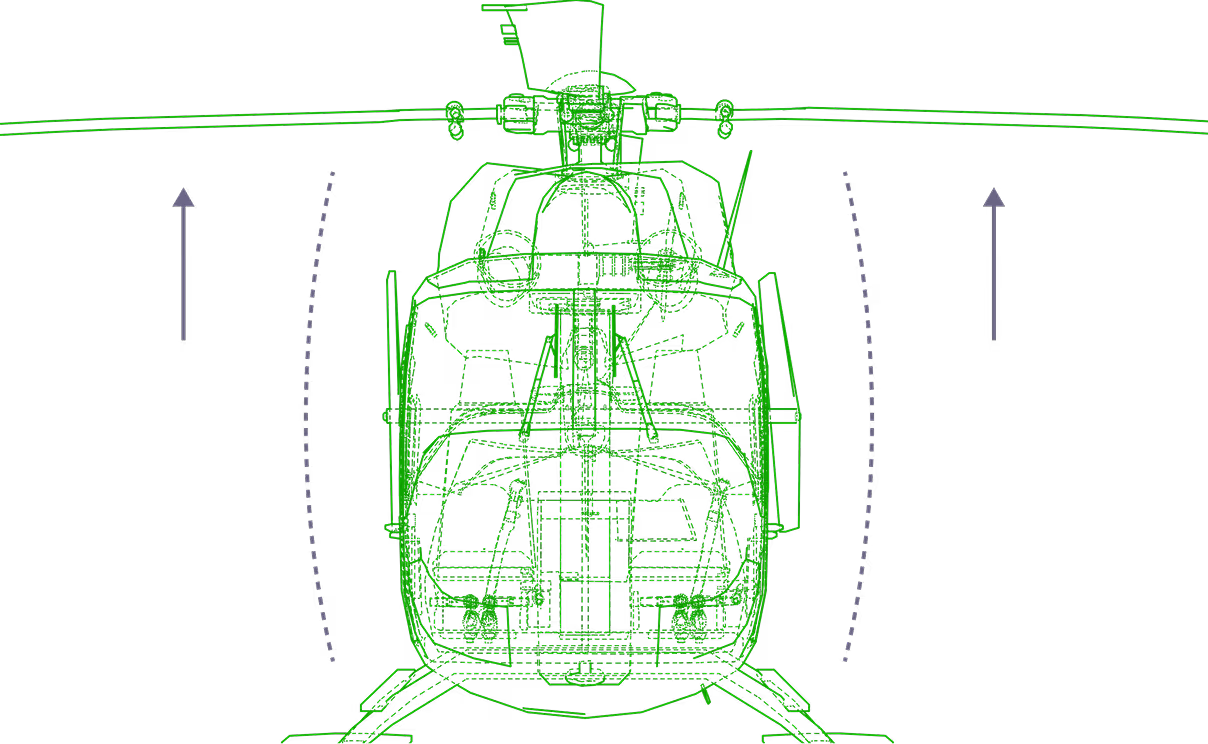
Challenges of Managing
Requirements in Defense
Defense engineering operates at a scale and security posture that most tools simply aren't built for. Programs span decades, involve hundreds of contractors, and must satisfy acquisition frameworks that demand rigorous traceability at every stage.
Programs often accumulate hundreds of thousands of requirements across multiple system increments, with traceability chains that span organizations and decades.
DoD acquisition frameworks (DoDI 5000 series) require traceable evidence from capability needs through system requirements, design, and test. Gaps surface during milestone reviews and can delay entire programs.
Security classification and ITAR restrictions mean data can't leave controlled environments. Most cloud-based tools are immediately disqualified.
Multi-contractor integration creates traceability blind spots. Requirements flow between prime contractors and subcontractors through documents and spreadsheets, and the connections between them are manually maintained at best.


Key Trace.Space Features for
Defense Teams
Air-Gapped AI
Trace.Space runs entirely within your security perimeter. The AI operates without any external calls, making it deployable in classified and controlled environments where other tools can't go.
Multi-Program Traceability
Manage requirements across programs, increments, and system-of-systems architectures. Maintain traceability that spans organizational boundaries and multi-decade timelines.
Acquisition Framework Alignment
Structure traceability to align with DoD acquisition milestones. Generate evidence artifacts that map to DoDI 5000 series requirements, so milestone reviews don't become traceability fire drills.
AI-Driven Gap Detection
The AI continuously scans for broken traces, missing verification evidence, and incomplete requirement decompositions. It surfaces problems while they're cheap to fix, not during a critical design review.
Contractor Coordination
Manage requirement allocations to subcontractors, track their deliverables against requirement sets, and maintain traceability across organizational boundaries.
Configuration and Baseline Management
Lock requirement baselines for program milestones. Compare versions across increments, track every change with full audit history, and maintain the configuration control defense programs demand.
Industry Standards and Security Compliance
Trace.Space supports all standards because the compliance workflows defense teams live by requires flexibility to adapt to the context they work in, with traceability structures designed for the standards auditors actually check.


Examples of Supported Standards:
/
MIL-STD-961 (Defense and Program-Unique Specifications)
/
MIL-STD-881 (Work Breakdown Structures for Defense Programs)
/
NIST SP 800-53 (Security and Privacy Controls)
/
DO-178C (where defense programs involve airborne software)
Examples of Platform Security:
/
SOC 2 Type II certified
/
ISO 27001 compliant
/
GDPR and CCPA ready
/
Cloud, private VPC, on-premise, or fully air-gapped deployment
Frequently Asked Questions About
Defense Requirements
How does Trace.Space keep ITAR-restricted and classified requirements data inside our environment?

Trace.Space keeps ITAR-restricted and classified requirements data inside your environment by deploying fully air-gapped, with no external network calls at any point. The AI runs inside your security perimeter, so requirements, traces, and verification evidence never leave the controlled environment. Programs governed by export controls or classification can run the platform on-premise or in a private VPC without routing data to outside services.
Can the AI features work in a fully air-gapped deployment with no internet access?
The AI features work in a fully air-gapped deployment because the models run locally inside your perimeter and make no external calls, even for inference. Gap detection, trace suggestions, and requirement analysis behave the same offline as they do in a connected environment, so nothing degrades when you cut network access. Classified programs get AI assistance without opening any path to outside networks.
How does Trace.Space maintain traceability across prime contractors and subcontractors?
Trace.Space maintains traceability across prime contractors and subcontractors by managing requirement allocations to each organization and tracking their deliverables against the assigned requirement sets. Traces hold across organizational boundaries instead of breaking when requirements move between teams through documents or spreadsheets. The AI flags missing or broken links, so allocation gaps surface before a milestone review rather than during one.
How does Trace.Space support DoD acquisition milestones and DoDI 5000 evidence?
Trace.Space supports DoD acquisition milestones by structuring traceability from capability needs through system requirements, design, and test, then generating the evidence artifacts DoDI 5000 series reviews ask for. Teams lock requirement baselines at each milestone and compare versions across increments with full change history. Milestone reviews become a record you produce on demand instead of a last-minute traceability scramble.
Which defense standards and security controls does Trace.Space support?
Trace.Space supports defense specification standards including MIL-STD-961 and MIL-STD-881, security and privacy controls under NIST SP 800-53, and DO-178C where programs involve airborne software. The platform itself is SOC 2 Type II certified and ISO 27001 compliant. Traceability structures adapt to the standards your auditors actually check rather than forcing one fixed template onto every program.
How does Trace.Space scale across a multi-decade program with hundreds of thousands of requirements?
Trace.Space scales across multi-decade programs by handling hundreds of thousands of interconnected requirements and traces across multiple system increments without performance degradation. A change introduced years into the program still shows its full downstream impact across hardware, software, and systems domains. The AI keeps scanning for broken traces and incomplete decompositions as the requirement set grows.
/
LATEST ARTICLES
Resources and Insights
.png)
News
/
%20(1)%20(1)%20(1).jpg)
Janis Vavere
As AI accelerates engineering, new hardware products and prototypes are coming out 10x faster but knowing what is being built, what changed and what has actually been tested becomes a matter of physical safety. Today, Trace.Space introduces Trinity.
Trace.Space Introduces Trinity, the Agent Harness to Accelerate Physical AI
.png)
Engineering
/
Janis Vavere
Defense and hardware startups keep winning fly-offs and then failing to produce fleets. The industry calls this a manufacturing problem. The constraint sits earlier than that: a prototype has to be right once, a fleet has to stay right across every variant while the design keeps moving, and the tools underneath were built for products that ship once.
Where Are the Hundred Thousand?
Product
/
Janis Vavere
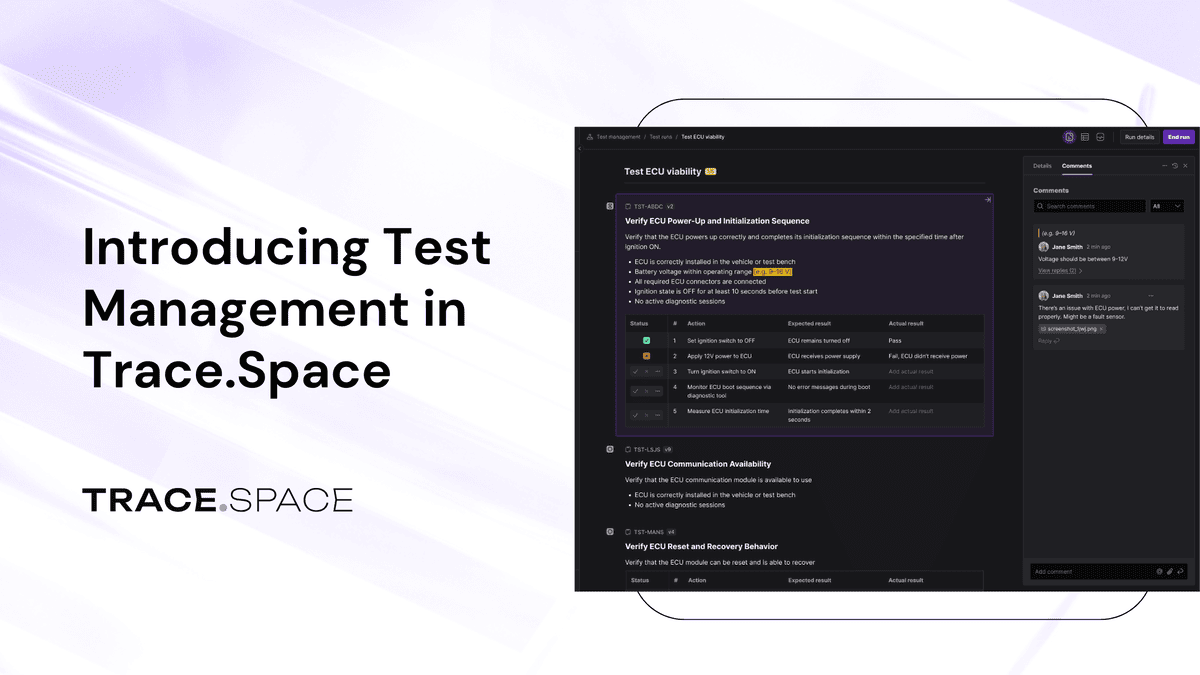
Test Management is now available in Trace.Space. You can define test cases as items, break them into steps, send them to a test run, hand that run to the person who will execute it, and see every result land back on the item that was tested.
Introducing Test Management in Trace.Space


Defense-grade complexity deserves defense-grade traceability. Not tools built for a simpler era.
See how Trace.Space fits into your engineering workflow.