
AI-Native Requirements Management for Automotive Engineering
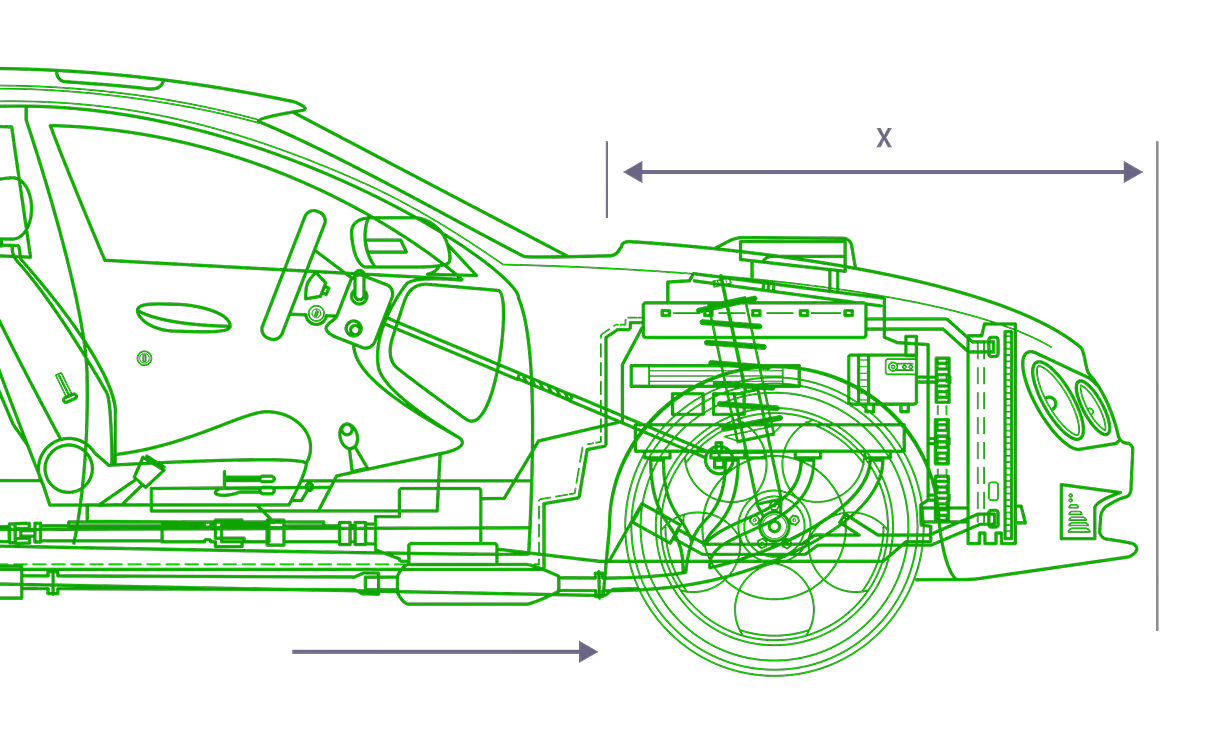
Vehicles have become software-defined platforms. A modern car can contain over 100 million lines of code, thousands of safety-critical requirements, and dozens of ECUs that all need to work together. Trace.Space gives automotive teams cross-domain traceability from system architecture through hardware, software, and electronics, with AI that finds the hidden blockers before they cause delays or safety issues.
Challenges of Managing
Requirements in Automotive
The automotive industry is in the middle of its biggest transformation in a century. Electrification, autonomous driving, and software-defined architecture have driven a complexity spike that legacy processes and tools were never designed for.
ISO 26262 requires full traceability from safety goals through functional, technical, and software requirements to test evidence. The chains are long, and they break easily.
A single change to an ECU software requirement can ripple across hardware interfaces, calibration data, and system-level safety cases. Without automated impact analysis, teams find these cascading effects too late.
Engineering teams span multiple domains (mechanical, electrical, software, electronics) and often multiple continents. Requirements live in different tools, and traceability across domain boundaries is fragile at best.
ASPICE assessments demand process maturity and traceability evidence that many teams assemble manually from scattered sources.


Key Trace.Space Features for
Automotive Teams
Cross-Domain Traceability
Trace requirements across mechanical, electrical, software, and electronics domains in one unified view. No more patching together traceability across siloed tools and spreadsheets.
ISO 26262 Safety Case Support
Build and maintain traceability from safety goals through functional safety requirements, technical safety requirements, and software safety requirements to verification evidence. See gaps in real time.
AI-Powered Change Impact Analysis
When a requirement changes, see every affected artifact across every domain instantly. Trace.Space maps the ripple effects that manual processes miss.
ASPICE-Ready Process Evidence
Generate traceability reports and coverage analyses that map directly to ASPICE base practices. Spend less time assembling evidence and more time engineering.
Variant and Configuration Management
Manage requirement variants across vehicle platforms, trim levels, and regional configurations without duplicating your entire traceability structure.
Cybersecurity Requirements Traceability
Track ISO 21434 cybersecurity requirements alongside functional safety requirements, with full traceability from threat analysis through security controls and validation.
Industry Standards and Security Compliance
Trace.Space supports all standards because the compliance workflows aeromotive teams live by requires flexibility to adapt to the context they work in, with traceability structures designed for the standards auditors actually check.

Examples of Supported Standards:
/
ISO 26262 (Functional Safety for Road Vehicles)
/
ASPICE (Automotive SPICE Process Assessment)
/
ISO 21434 (Cybersecurity Engineering for Road Vehicles)
/
ISO/SAE 21448 (SOTIF – Safety of the Intended Functionality)
/
AUTOSAR (AUTomotive Open System ARchitecture)
Examples of Platform Security:
/
SOC 2 Type II certified
/
ISO 27001 compliant
/
GDPR and CCPA ready
/
Cloud, private VPC, on-premise, or fully air-gapped deployment
Frequently Asked Questions About Automotive Requirements
What is ASIL, and how does it affect requirements management?

ASIL, or Automotive Safety Integrity Level, is the risk classification ISO 26262 assigns to a hazard, from ASIL A at the lowest to ASIL D at the highest. The level sets how much verification a safety requirement needs. Trace.Space maintains traceability from safety goals through functional, technical, and software safety requirements to verification evidence, so each requirement carries the evidence its ASIL demands and gaps show up in real time.
What is the difference between ASPICE and ISO 26262?
ASPICE and ISO 26262 differ in what they assess: ISO 26262 governs functional safety of the vehicle, while ASPICE measures the maturity of the development process behind it. A program often has to satisfy both, since ASPICE wants process and traceability evidence while ISO 26262 wants safety requirements traced to verification. Trace.Space produces ISO 26262 safety-case traceability and ASPICE coverage reports from the same requirement data.
Can one platform manage ISO 26262, ASPICE, and ISO 21434 in the same project?
Yes, one platform can manage ISO 26262, ASPICE, and ISO 21434 together, and Trace.Space tracks all three against the same requirements. Functional safety, process evidence, and cybersecurity traceability share a single data model. That removes the manual work of reconciling safety, security, and process evidence from separate tools when an audit arrives.
How does Trace.Space manage requirements for software-defined vehicles?
Trace.Space manages software-defined-vehicle requirements by tracing them across mechanical, electrical, software, and electronics domains in one view, including the thousands of safety-critical requirements and dozens of ECUs a modern car carries. When an ECU software requirement changes, the platform shows every affected hardware interface, calibration input, and safety case instantly. Variant management then keeps those requirements straight across platforms, trim levels, and regional configurations.
How does Trace.Space support SOTIF (ISO/SAE 21448)?
Trace.Space supports SOTIF, or ISO/SAE 21448, by tracing safety-of-the-intended-functionality requirements alongside ISO 26262 functional safety requirements in the same structure. SOTIF covers hazards that come from performance limitations rather than system faults, which matters most for ADAS and automated driving. The platform links those requirements to scenario analysis and verification evidence, so coverage stays visible as the functionality evolves.
How does AI help catch requirement issues across multiple ECUs and domains?
AI helps catch requirement issues by mapping the ripple effects of a change across every domain, so a single ECU requirement edit shows its impact on hardware interfaces, calibration, and system-level safety cases at once. It also flags missing context, conflicts, and coverage gaps that manual reviews tend to miss across dozens of ECUs. Engineers stay in control and decide what to accept, since the AI suggests rather than dictates.
/
LATEST ARTICLES
Resources and Insights
.png)
News
/
%20(1)%20(1)%20(1).jpg)
Janis Vavere
As AI accelerates engineering, new hardware products and prototypes are coming out 10x faster but knowing what is being built, what changed and what has actually been tested becomes a matter of physical safety. Today, Trace.Space introduces Trinity.
Trace.Space Introduces Trinity, the Agent Harness to Accelerate Physical AI
.png)
Engineering
/
Janis Vavere
Defense and hardware startups keep winning fly-offs and then failing to produce fleets. The industry calls this a manufacturing problem. The constraint sits earlier than that: a prototype has to be right once, a fleet has to stay right across every variant while the design keeps moving, and the tools underneath were built for products that ship once.
Where Are the Hundred Thousand?
Product
/
Janis Vavere
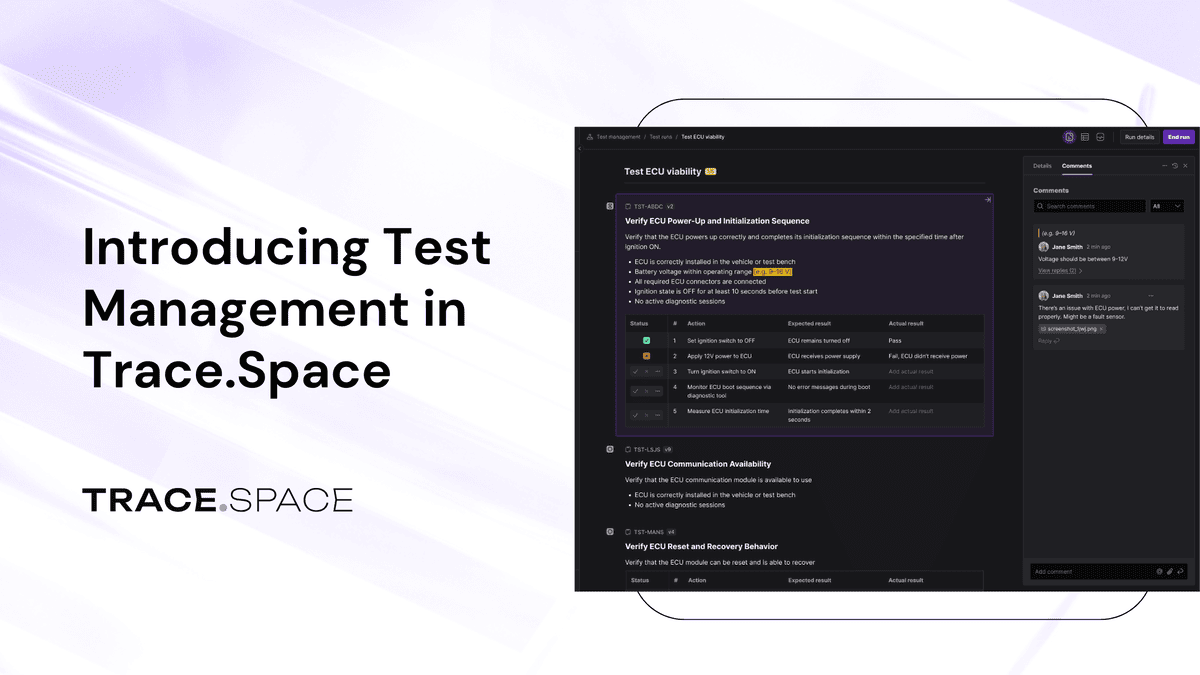
Test Management is now available in Trace.Space. You can define test cases as items, break them into steps, send them to a test run, hand that run to the person who will execute it, and see every result land back on the item that was tested.
Introducing Test Management in Trace.Space


Your vehicles are software-defined. Your requirements management should be too.
See how Trace.Space fits into your engineering workflow.