
AI-Native Requirements Management for Medical Device Development
Medical device teams face a unique pressure: move fast enough to reach patients who need your product, while maintaining the regulatory rigor that keeps them safe. Trace.Space connects requirements, design controls, risk management, and verification evidence in one traceable structure, so your team can iterate with confidence and walk into any audit prepared.
Challenges of Managing Requirements in Medical Device Development
Medical device engineering operates under some of the most demanding regulatory frameworks in any industry. And as devices become more software-intensive and connected, the complexity of maintaining compliant traceability is growing fast.
FDA 21 CFR Part 820 and ISO 13485 require a design control process with full traceability from user needs through design inputs, design outputs, and verification/validation. Every link must be documented and auditable.
IEC 62304 adds software lifecycle traceability requirements that compound with device-level controls. Software changes must be traced to system-level requirements and risk controls.
ISO 14971 risk management requires traceability from hazard identification through risk controls to verification of risk control effectiveness. Many teams maintain this in spreadsheets, and it breaks down as the device grows in complexity.
Iterative development creates constant change. Every design change triggers traceability updates across requirements, risk files, and verification plans, and if those updates lag, your regulatory submission is at risk.



Key Trace.Space Features for
Medical Device Teams
Design Control Traceability
Trace the full design control thread from user needs through design inputs, outputs, verification, and validation. See the complete chain in one view, always current, always auditable.
Risk Management Integration
Connect ISO 14971 risk analysis directly to requirements. Trace from identified hazards through risk controls to verification of control effectiveness, with AI that flags gaps in risk coverage.
Software Lifecycle Traceability
For software-intensive devices, maintain IEC 62304 traceability from system requirements through software architecture, detailed design, unit implementation, and integration testing.
AI-Driven Completeness Monitoring
AI continuously monitors your traceability matrix for broken links, missing verification evidence, and incomplete risk control traces. You'll know your submission readiness at any point, not just at the end.
Change Impact Analysis
When a design input changes, see every affected output, risk control, and verification activity instantly. Make design changes with full visibility into regulatory impact.
Audit-Ready Reporting
Generate traceability matrices, coverage reports, and design history evidence directly from the platform. No more manual assembly from scattered tools before an audit.
Industry Standards and Security Compliance
Trace.Space supports all standards because the compliance workflows medical teams live by requires flexibility to adapt to the context they work in, with traceability structures designed for the standards auditors actually check.


Examples of Supported Standards:
/
ISO 13485 (Quality Management Systems for Medical Devices)
/
IEC 62304 (Medical Device Software Lifecycle Processes)
/
ISO 14971 (Application of Risk Management to Medical Devices)
/
FDA 21 CFR Part 820 (Quality System Regulation)
Examples of Platform Security:
/
SOC 2 Type II certified
/
ISO 27001 compliant
/
GDPR and CCPA ready
/
Cloud, private VPC, on-premise, or fully air-gapped deployment
Frequently Asked Questions About
Medical Device Requirements
How does Trace.Space build a design control traceability matrix for a medical device?

Trace.Space builds a design control traceability matrix by linking user needs to design inputs, design outputs, verification, and validation in one connected structure, then generating the matrix directly from those links. You see the full design control thread in a single view that stays current as the device changes, so the matrix reflects the real state of the project instead of a snapshot you rebuild by hand.
Can Trace.Space help us compile a Design History File (DHF)?
Yes. Trace.Space generates design history evidence directly from the platform, including traceability matrices and coverage reports pulled from your live design control data. Instead of assembling DHF documentation from scattered tools before an audit, you produce the evidence from the same structure your team works in every day.
How does Trace.Space help us get ready for an FDA submission?
Trace.Space tracks your submission readiness as you work, monitoring the traceability matrix for gaps in verification evidence and risk control coverage so issues surface early instead of at the end. It supports FDA 21 CFR Part 820 structures and generates the coverage reports and design history evidence an FDA submission relies on, directly from the platform.
Does Trace.Space maintain bidirectional traceability for IEC 62304 software?
Yes. Trace.Space maintains traceability across the full IEC 62304 chain, from system requirements through software architecture, detailed design, unit implementation, and integration testing. Because every link is connected, you can trace forward from a requirement to its tests and back from a test to the requirement it verifies, and change impact analysis shows every affected item when something in that chain moves.
Can we manage device design, software, and risk for one product in a single system?
Yes. Trace.Space connects design controls, IEC 62304 software lifecycle traceability, and ISO 14971 risk management in one structure, so the device design, its software, and its risk file live in the same connected system. When a design input changes, you see the affected software requirements, risk controls, and verification activities together instead of reconciling separate tools.
How does Trace.Space keep traceability audit-ready as the design changes?
Trace.Space keeps your traceability audit-ready by updating the connected structure as the design changes and flagging broken links, missing verification evidence, and incomplete risk control traces as they appear. When a design input changes, change impact analysis shows every affected output, risk control, and verification activity right away, so updates don't lag behind the design and put your submission at risk.
/
LATEST ARTICLES
Resources and Insights
.png)
News
/
%20(1)%20(1)%20(1).jpg)
Janis Vavere
As AI accelerates engineering, new hardware products and prototypes are coming out 10x faster but knowing what is being built, what changed and what has actually been tested becomes a matter of physical safety. Today, Trace.Space introduces Trinity.
Trace.Space Introduces Trinity, the Agent Harness to Accelerate Physical AI
.png)
Engineering
/
Janis Vavere
Defense and hardware startups keep winning fly-offs and then failing to produce fleets. The industry calls this a manufacturing problem. The constraint sits earlier than that: a prototype has to be right once, a fleet has to stay right across every variant while the design keeps moving, and the tools underneath were built for products that ship once.
Where Are the Hundred Thousand?
Product
/
Janis Vavere
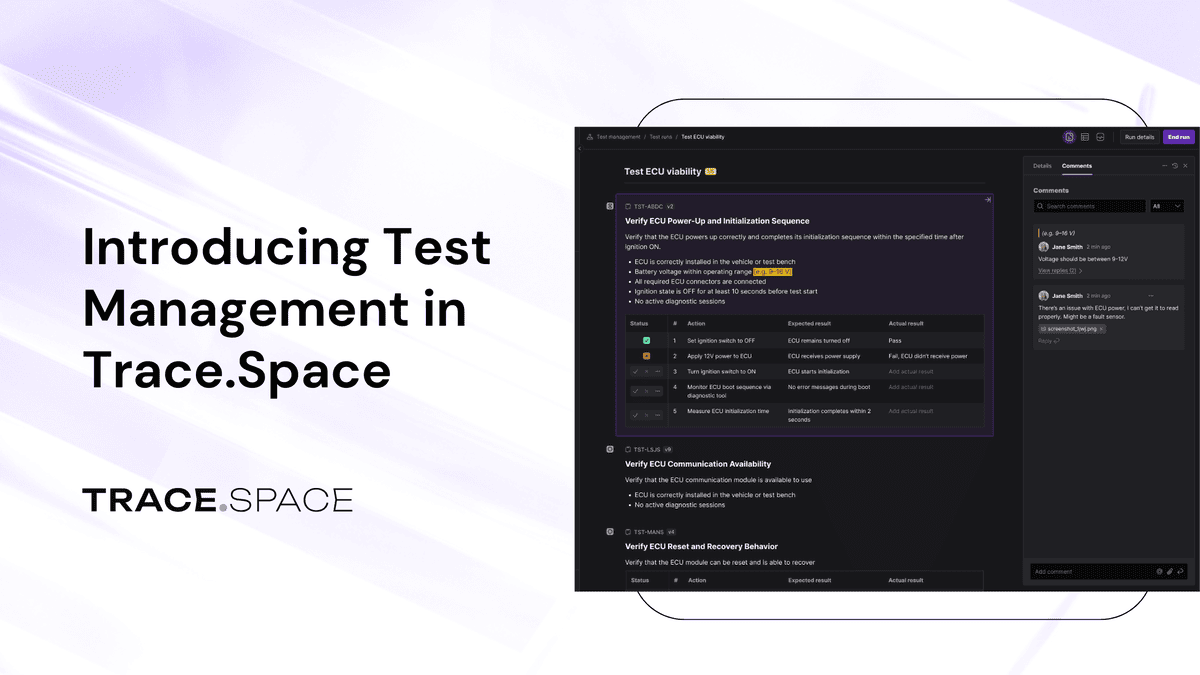
Test Management is now available in Trace.Space. You can define test cases as items, break them into steps, send them to a test run, hand that run to the person who will execute it, and see every result land back on the item that was tested.
Introducing Test Management in Trace.Space


Regulatory confidence shouldn't require a last-minute scramble.
See traceability that's always audit-ready.