
AI-Native Requirements Management for Semiconductor Design
Modern SoCs and ASICs are among the most complex engineered products on the planet. Thousands of IP blocks, cross-domain dependencies from RTL to firmware to system integration, and safety standards that demand full traceability from specification to silicon validation. Trace.Space gives semiconductor teams the coordination layer to manage this complexity and trace every requirement through the entire design chain.
Challenges of Managing Requirements in Semiconductor Design
Semiconductor complexity has outpaced the tools most teams use to manage it. As chips become more software-defined and safety-critical, the traceability demands on design teams have grown faster than the processes to handle them.
A modern SoC can contain thousands of IP blocks with interconnected requirements spanning digital logic, analog, firmware, and system software. Traceability across these boundaries is fragmented at best.
Functional safety standards like ISO 26262 (automotive semiconductors) and IEC 61508 require traceable safety cases from hardware safety requirements through design, verification, and validation. Building these manually across IP blocks is unsustainable.
Design reuse means requirements are inherited, modified, and extended across projects. Without traceable lineage, teams inherit problems alongside IP.
EDA tools, PLM systems, and verification environments each hold pieces of the traceability picture, but nothing connects them into a coherent whole.
Key Trace.Space Features for Semiconductor Teams
IP-to-System Traceability
Trace requirements from system-level specifications through IP block requirements, RTL design, firmware interfaces, and silicon validation. See the full design chain across every domain.
Safety Case Management
For safety-critical semiconductors, build traceable cases from hardware safety requirements through FMEDA, diagnostic coverage analysis, and safety verification, with AI monitoring completeness.
Cross-Domain Coordination
Connect requirements across digital, analog, firmware, and system software domains. See how changes in one domain affect others before you commit to a design decision.
EDA and PLM Integration
Connect your existing EDA tools, PLM systems, and verification environments to Trace.Space via open APIs. Pull traceability together without replacing your design toolchain.
AI-Driven Change Impact
When a requirement or IP block changes, see every downstream artifact affected, from RTL modules to test benches to system integration tests. Trace.Space maps the impact that manual processes miss.
Design Reuse with Traceable Lineage
Track the heritage of reused IP requirements across projects. Know exactly what was inherited, what was modified, and what new requirements were derived.
Industry Standards and Security Compliance
Trace.Space supports all standards because the compliance workflows semiconductor teams live by requires flexibility to adapt to the context they work in, with traceability structures designed for the standards auditors actually check.
Examples of Supported Standards:
ISO 26262 (Functional Safety for Automotive Semiconductors)
IEC 61508 (Functional Safety for Electronic Systems)
JEDEC Standards (Semiconductor Engineering Standards)
Examples of Platform Security:
SOC 2 Type II certified
ISO 27001 compliant
GDPR and CCPA ready
Cloud, private VPC, on-premise, or fully air-gapped deployment
Frequently Asked Questions About Semiconductor Requirements
How does Trace.Space keep requirements traceable across thousands of IP blocks?
Trace.Space keeps requirements traceable across thousands of IP blocks by connecting system-level specifications, IP block requirements, RTL design, firmware interfaces, and silicon validation into one chain. Your EDA tools, PLM systems, and verification environments each hold part of that picture, so Trace.Space pulls those pieces together through open APIs instead of leaving traceability fragmented across separate tools.
Does Trace.Space support bidirectional traceability for ISO 26262 and IEC 61508 safety cases?
Yes. Trace.Space builds traceable safety cases from hardware safety requirements through FMEDA, diagnostic coverage analysis, and safety verification, with AI monitoring completeness against ISO 26262 and IEC 61508. Because the links connect in both directions, you can trace from a safety requirement down to its verification and back from a verification result to the requirement it covers.
How does Trace.Space track reused IP and its requirement lineage across projects?
Trace.Space tracks reused IP by recording the lineage of each inherited requirement across projects, so you know what was inherited, what was modified, and what new requirements were derived. You can see a block's heritage before you reuse it, which keeps teams from inheriting hidden problems along with the IP.
Can we link test cases to the safety requirements they verify?
Yes. Trace.Space links verification activities to the requirements they cover, so each safety requirement connects to the verification evidence that demonstrates it. You get a direct line from any verification result back to the safety requirement it covers, which is what auditors check in a safety case.
When an IP block or requirement changes, what downstream artifacts does Trace.Space flag?
When an IP block or requirement changes, Trace.Space flags every downstream artifact affected, from RTL modules to test benches to system integration tests. It maps the ripple effects that manual processes miss, so you see the full impact of a change across domains before you commit to it.
Does Trace.Space handle ASIC design requirements for regulated markets?
Yes. Trace.Space manages ASIC and SoC requirements across digital, analog, firmware, and system software, tracing each one from system specification through IP blocks and RTL to silicon validation. For regulated markets, it builds the ISO 26262 and IEC 61508 safety cases those programs require, traced from hardware safety requirements through verification.
//
LATEST ARTICLES
Insights & Resources
Product
/

Janis Vavere
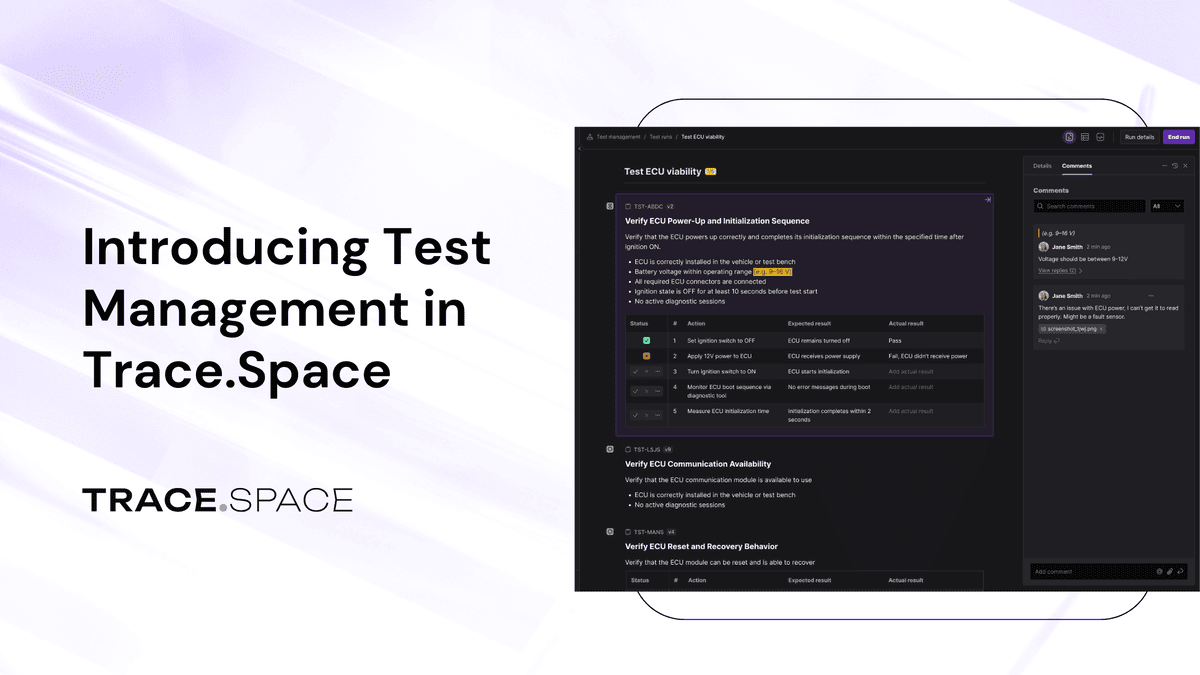
Test Management is now available in Trace.Space. You can define test cases as items, break them into steps, send them to a test run, hand that run to the person who will execute it, and see every result land back on the item that was tested.
Introducing Test Management in Trace.Space
.png)
Engineering
/

Matt Maclaine
Requirements live in one tool, tests in another, and the link between them is maintained by hand. This post argues verification status should be computed instead of typed into a dropdown, and walks through what hand-maintained traceability actually costs: double entry, statusing that goes stale overnight, and stale passes that look exactly like valid ones.
Verification Is Just Like, Your Opinion, Man
Engineering
/

Mikus Krams
Most teams know they need to bring AI into engineering, but have no working reference for what that actually looks like inside a regulated, multi-domain program. Agentic systems engineering is that reference. It is the practice of running engineering work, requirements analysis, traceability, verification, change impact, compliance, through AI agents that operate inside an engineering data model under human review. This article defines the term, separates it from neighboring ideas, and shows what it looks like in the regulated programs where it has the most consequence.
What Is Agentic Systems Engineering

Your silicon is getting more complex every generation. Your traceability needs to keep pace.
Your silicon is getting more complex every generation. Your traceability needs to keep pace.
See traceability that's always audit-ready.