
AI-Native Requirements Traceability for Regulated Software Teams
Software teams in government, financial services, and critical infrastructure build under compliance frameworks that demand full traceability from requirements through code, tests, and audit evidence. The problem? That traceability is spread across a dozen tools and assembled manually. Trace.Space pulls it all together, giving your team a single coordinated view of every requirement, its implementation, and its compliance trail.
Challenges of Managing Requirements in Regulated Software
Most software teams don't struggle with requirements because the work is inherently hard. They struggle because the tools weren't designed for compliance-grade traceability, and the process overhead of maintaining it manually drains time from actual development.
Compliance frameworks like NIST SP 800-53, FedRAMP, and SOX require traceable evidence that security and control requirements are implemented, tested, and monitored. Most teams assemble this manually from Jira, Git, test tools, and documents.
Government software contracts demand requirements traceability matrices (RTMs) that map every requirement to its implementation and verification. Producing these from fragmented tools is a recurring time sink.
Financial services teams face SOX and regulatory audit requirements that demand traceable change management. Every requirement change needs a documented trail to code, test, and approval.
As codebases grow and teams scale, the connections between requirements, code, and tests become harder to maintain. Broken traceability shows up during audits, not during development.
Key Trace.Space Features for Regulated Software Teams
Requirements-to-Code Traceability
Trace requirements through architecture, implementation, and test evidence in one unified view. See which requirements are implemented, which are tested, and which have gaps.
Compliance Evidence Generation
Generate requirements traceability matrices, coverage reports, and compliance evidence directly from the platform. No more manual assembly from scattered tools before an audit.
AI-Driven Gap Detection
AI continuously scans for requirements without test coverage, implementation artifacts without linked requirements, and broken traces in your compliance chain. Issues surface in real time, not during audit preparation.
Change Management Traceability
Every requirement change is traced to affected code, tests, and approvals. Satisfy SOX and regulatory change management requirements with an audit trail that maintains itself.
Developer Tool Integration
Trace.Space connects to the tools your developers already use: Jira, Git, GitHub, GitLab, and CI/CD pipelines. Traceability happens in the background of existing workflows, not as a separate manual process.
Security Requirements Tracking
Map NIST SP 800-53 controls and other security requirements to their implementation and verification evidence. Maintain continuous awareness of your security compliance posture.
Industry Standards and Security Compliance
Trace.Space supports all standards because the compliance workflows software teams live by requires flexibility to adapt to the context they work in, with traceability structures designed for the standards auditors actually check.
Examples of Supported Standards:
NIST SP 800-53 (Security and Privacy Controls)
FedRAMP (Federal Risk and Authorization Management Program)
FISMA (Federal Information Security Modernization Act)
SOX (Sarbanes-Oxley Act)
GDPR (General Data Protection Regulation)
ISO 27001 (Information Security Management)
Examples of Platform Security:
SOC 2 Type II certified
ISO 27001 compliant
GDPR and CCPA ready
Cloud, private VPC, on-premise, or fully air-gapped deployment
Frequently Asked Questions About Regulated Software Requirements
How does Trace.Space build a requirements traceability matrix from our Jira and Git data?
Trace.Space builds the requirements traceability matrix by connecting to Jira, Git, GitHub, GitLab, and your CI/CD pipelines. It maps every requirement to its implementation and test evidence, then generates the matrix and coverage reports directly from the platform. Developers stay in the tools they already use, so no one assembles the matrix by hand before an audit.
How does traceability stay current when our code changes every sprint?
Traceability stays current because Trace.Space's AI continuously scans for broken traces, requirements without test coverage, and implementation artifacts that lost their linked requirement. Issues surface in real time as commits and changes land, not weeks later during audit prep. Your team fixes a broken link while the context is fresh, instead of reconstructing it after the fact.
Can we show an auditor who approved each requirement change for SOX?
Yes. Trace.Space traces every requirement change to the affected code, tests, and approvals, which gives you the documented trail SOX and financial audits ask for. When an auditor asks who signed off on a change, the answer comes from the platform rather than a manual search across Jira tickets and email.
How is this different from the traceability plugins already in Jira or our ALM?
Native plugins trace work inside one tool. Trace.Space connects requirements, code, tests, and approvals across Jira, Git, your CI/CD pipeline, and documents, so the trace holds even when the evidence lives in different systems. It also adds AI gap detection and ready-to-export compliance evidence, which single-tool traceability does not cover.
What does Trace.Space handle for FedRAMP and NIST SP 800-53 authorization?
For FedRAMP and NIST SP 800-53, Trace.Space maps security and control requirements to their implementation and verification evidence, then keeps that mapping current as the system changes. You can deploy in cloud, private VPC, on-premise, or fully air-gapped environments, which matters when an authorization boundary restricts where data lives. The platform generates the coverage reports and evidence auditors check, directly from the source data.
How does Trace.Space keep AI gap alerts from overwhelming developers?
Trace.Space's AI flags specific, checkable gaps: a requirement with no test coverage, an artifact with no linked requirement, a broken trace in the compliance chain. Each alert points to a real traceability problem rather than a vague warning, and engineers review, accept, or override every suggestion. The AI suggests; your team decides what to act on.
//
LATEST ARTICLES
Insights & Resources
Product
/

Janis Vavere
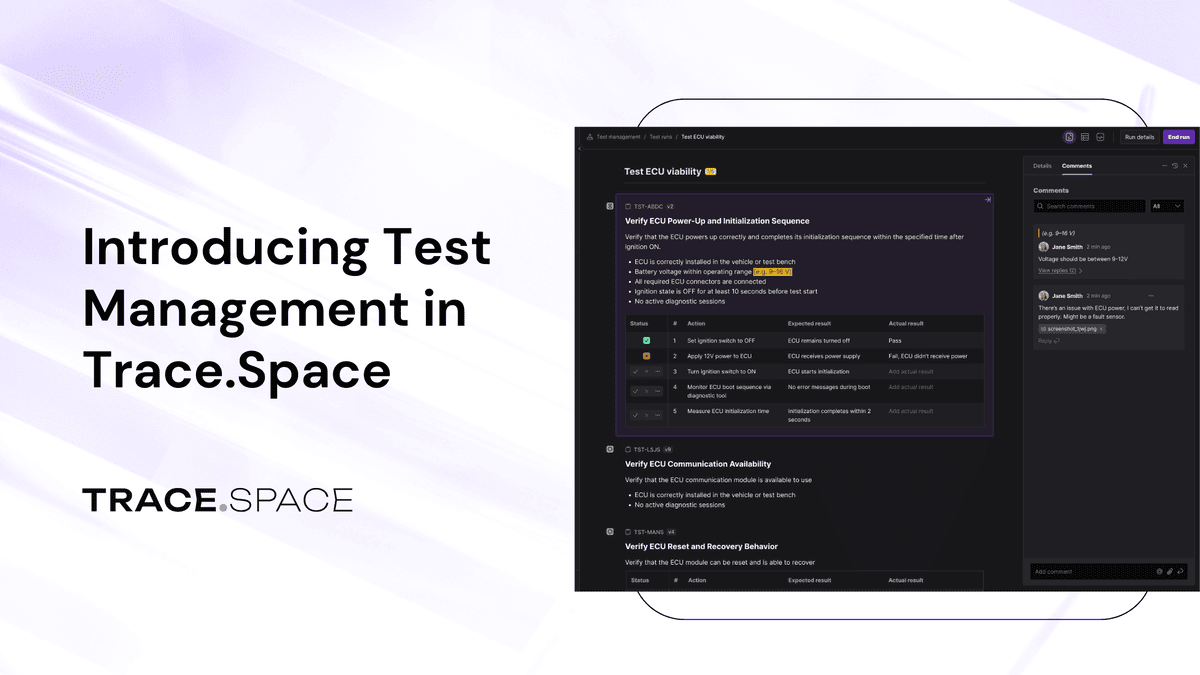
Test Management is now available in Trace.Space. You can define test cases as items, break them into steps, send them to a test run, hand that run to the person who will execute it, and see every result land back on the item that was tested.
Introducing Test Management in Trace.Space
.png)
Engineering
/

Matt Maclaine
Requirements live in one tool, tests in another, and the link between them is maintained by hand. This post argues verification status should be computed instead of typed into a dropdown, and walks through what hand-maintained traceability actually costs: double entry, statusing that goes stale overnight, and stale passes that look exactly like valid ones.
Verification Is Just Like, Your Opinion, Man
Engineering
/

Mikus Krams
Most teams know they need to bring AI into engineering, but have no working reference for what that actually looks like inside a regulated, multi-domain program. Agentic systems engineering is that reference. It is the practice of running engineering work, requirements analysis, traceability, verification, change impact, compliance, through AI agents that operate inside an engineering data model under human review. This article defines the term, separates it from neighboring ideas, and shows what it looks like in the regulated programs where it has the most consequence.
What Is Agentic Systems Engineering

Compliance traceability shouldn't be a manual process. See what it looks like when it's built in.
Compliance traceability shouldn't be a manual process. See what it looks like when it's built in.
See how Trace.Space fits into your engineering workflow.