
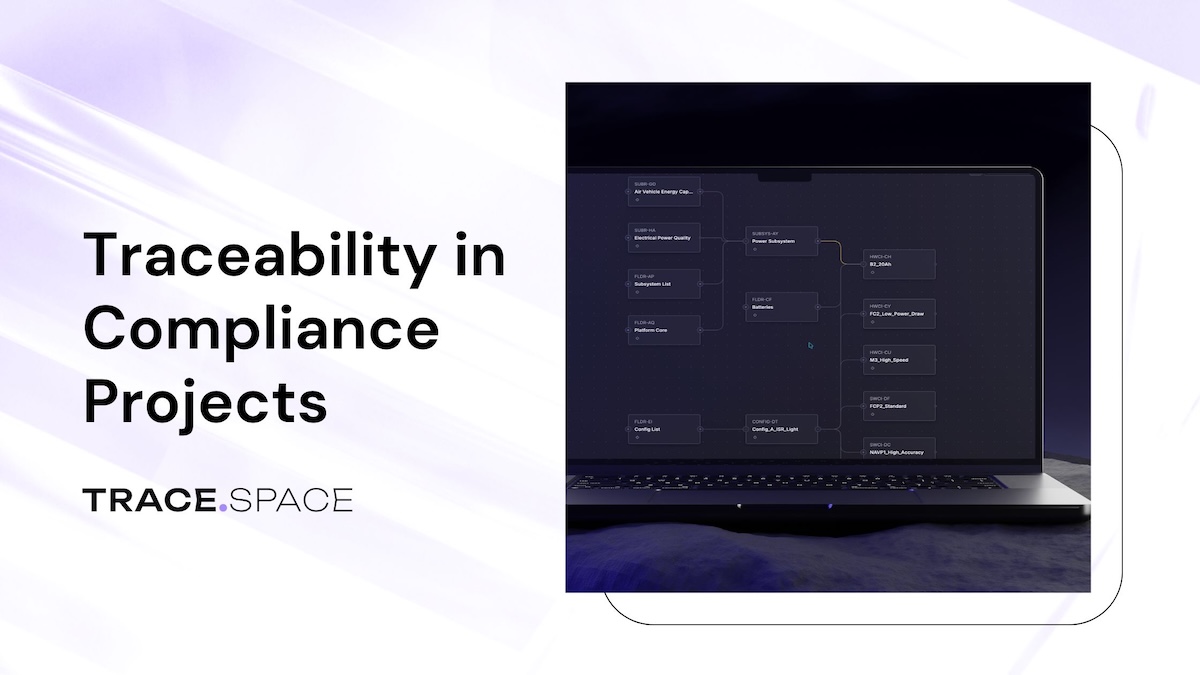
Traceability in Compliance Projects: ISO, ASPICE, DO-178C & Regulated Standards
Engineering
%20(1)%20(1)%20(1).jpg)
Janis Vavere
Mar 2, 2026


If you work in hardware manufacturing under regulatory oversight, you already know the pressure. Regulatory requirements are multiplying, product complexity is growing, and every audit demands documented evidence that your engineering outputs connect back to the standards they must satisfy. According to PwC's Global Compliance Survey (2025), 85% of organizations say compliance requirements have grown more complex over the past three years. Global fines for non-compliance reached $14 billion in 2024 (Thomson Reuters Regulatory Intelligence via StarCompliance), and the cost hits harder in regulated industries where a single traceability gap can delay certification by months.
This article covers requirements traceability in compliance projects: the discipline that connects regulations to engineering decisions to test results across automotive, aerospace, medical device, and defense programs. For a foundational overview of the concept, see our guide to requirements traceability.
For systems engineers, program managers, and quality engineers working under ISO 26262, ASPICE, DO-178C, and related standards, traceability is the mechanism that holds the compliance chain together - from the regulation that drives a requirement, through design and implementation, to the verification record that proves conformance. The sections below break down what each major standard demands, how to manage traceability across multiple frameworks simultaneously, and what separates manual processes from the AI-powered approaches replacing them.
Key takeaways
- Global fines for non-compliance reached $14 billion in 2024 (Thomson Reuters Regulatory Intelligence via StarCompliance), and 85% of organizations say compliance requirements have grown more complex over the past three years (PwC Global Compliance Survey, 2025). A single traceability gap can delay certification by months.
- ISO 26262, ASPICE, DO-178C, ISO 13485, and IEC 62304 all mandate requirements traceability, but each standard defines different evidence depth, granularity, and review processes. A single automotive ECU may need to satisfy ISO 26262 for functional safety, ASPICE for process maturity, and ISO/SAE 21434 for cybersecurity simultaneously.
- A harmonized compliance model maps where standards overlap and where they diverge. ISO 26262 and ASPICE both require bidirectional traceability, so trace links can be shared, but evidence documentation differs: ISO 26262 requires a safety case argument while ASPICE demands process-conformance records.
- The compliance traceability workflow runs through nine steps, from regulatory requirement identification through certification documentation production. Each step creates specific trace links, and a change at any step triggers impact analysis in both directions across the full chain.
- 47% of organizations reported failing a formal audit two to five times in the past three years (Coalfire, 2024). Organizations that treat traceability as a shared architectural layer across compliance frameworks gain efficiency with each added standard, while those treating each standard as a separate documentation project multiply their work with every new regulation.
What Is Traceability?
Requirements traceability is the documented linkage between engineering artifacts across the product lifecycle. It connects requirements to design elements, design elements to implementation, implementation to test cases, and test cases to verification results. When every link in this chain is captured and maintained, engineering teams can answer two questions that every auditor will ask: "Where did this requirement come from?" and "How do you know it was satisfied?"
The Requirements Traceability Matrix (RTM) is the primary instrument for capturing and managing trace links.
An RTM maps each requirement to its downstream design decisions, implementation artifacts, and verification results.
Coverage, the percentage of requirements with complete trace chains from origin to evidence, is the metric that determines whether traceability is audit-ready or incomplete. A 95% coverage figure means 5% of requirements have no verified connection to test results, and those gaps are exactly where auditors focus. Baselines freeze the state of requirements and their trace relationships at defined milestones, creating versioned snapshots that auditors can review against specific certification submissions.
Traceability follows the structure of the V-model, running along the left side (decomposition from system requirements to detailed design) and the right side (integration and verification from unit testing up to system validation). V&V depends on traceability: verification confirms that each requirement was implemented correctly, and validation confirms the right product was built. Without trace links connecting both sides of the V, neither claim is provable.
Requirements traceability operates in several directions:
- Forward traceability tracks requirements downstream to their implementation and tests
- Backward traceability connects test results and implementation artifacts upstream to their originating requirements
- Bidirectional traceability combines both directions.
For teams building products where a design change crosses discipline boundaries, horizontal traceability prevents coordination failures. For a deeper look at traceability types and end-to-end coverage, see our dedicated traceability guide.
Industry analyses suggest that weak requirements traceability is a root cause in over 50% of product delays and costly post-launch quality issues in regulated sectors (ComplianceQuest, 2025).
Meeting ISO Traceability Requirements
Different compliance standards impose different traceability requirements. The depth of trace links demanded, the granularity of evidence expected, and the specific artifacts that must connect vary across ISO standards, process maturity models, and domain-specific certification frameworks. The following subsections break down what each major framework requires.
1. Traceability in ISO Standards (ISO 9001, ISO 26262, ISO 13485)
Three ISO standards illustrate how traceability rigor scales with risk and regulatory scope.
ISO 9001 sets the baseline. As a quality management system standard, it requires organizations to maintain product identification, measurement traceability, and documented information that proves outputs meet inputs. Traceability under ISO 9001 is process-level: it asks whether the organization can demonstrate consistent execution, not whether individual safety requirements trace to specific test results.
ISO 26262 raises the bar significantly for automotive functional safety. The standard assigns Automotive Safety Integrity Levels (ASIL A through D) to safety requirements, and ASIL level directly determines traceability rigor. ASIL D, the highest classification, requires bidirectional traceability between hazard analysis and risk assessment (HARA), safety goals, functional safety requirements, technical safety requirements, hardware and software implementation, and verification results. Every safety requirement must trace forward to its implementation and backward to the hazard it addresses. Modern vehicles contain over 100 ECUs with thousands of interdependent requirements each (Visure Solutions, 2025), making manual traceability at this depth impractical.
ISO 13485 governs medical device quality management systems. It requires traceability across the full design and development lifecycle: design inputs to design outputs, design verification, and design validation. Risk management integration runs through the design history file (DHF), and traceability must support post-market surveillance and product recall capabilities. Where a recall demand traces back to the original design decision, the trace chain must be intact.
2. Traceability in ASPICE
ASPICE functions as a process maturity model for automotive software and systems development, and for Tier 1 suppliers working with major OEMs, it is effectively mandatory. Traceability requirements span multiple process areas:
- SYS.2 (system requirements analysis)
- SYS.3 (system architectural design)
- SWE.1 through SWE.6 covering software engineering processes from requirements elicitation through testing.
The ASPICE traceability chain runs from system requirements through software requirements, architecture, detailed design, source code, unit tests, integration tests, and system tests. Each artifact must connect to its neighbors in both directions. Bidirectional traceability is a requirement starting at ASPICE Level 2, meaning every requirement must trace forward to its implementation and test artifacts and backward to its parent requirement or stakeholder need.
At ASPICE Level 3, the bar rises again. Traceability must follow a defined, standardized process across the entire organization, not just exist on individual projects.
The difference between Level 2 and Level 3 is the difference between teams maintaining trace links because a project plan requires it and an organization enforcing a consistent traceability process through documented standards that apply across all programs.
3. Traceability in DO-178C
DO-178C takes an objectives-based approach to airborne software certification, and traceability is the primary mechanism for demonstrating that each lifecycle objective has been met.
Design Assurance Levels (DAL A through E) determine both the number of objectives a project must satisfy and the strictness of traceability required. DAL A, assigned to software whose failure could cause catastrophic conditions, demands the most complete trace chains.
The DO-178C traceability chain links:
- system requirements to high-level software requirements
- high-level requirements to low-level software requirements
- low-level requirements to source code
- source code to test cases, test procedures, and test results.
What distinguishes DO-178C from most other standards is its requirement for structural coverage analysis, which traces test execution against source code structure to verify that testing exercised the code adequately, not just that it tested against requirements.
Hardware aspects of airborne electronic systems fall under DO-254, which carries its own traceability requirements. For systems that combine software (DO-178C) and programmable hardware (DO-254), the two traceability chains must align at the system requirements level, creating a coordination challenge that many aerospace programs manage across separate tools and teams.
Other Regulated Frameworks
IEC 62304 governs medical device software lifecycle processes, using risk classes (A, B, and C) to scale traceability depth much like ASIL does for automotive. Class C software, where failure could result in death or serious injury, requires full traceability from software requirements through architecture, implementation, and testing.
FDA 21 CFR Part 11 applies to electronic records and electronic signatures, requiring audit trails for any electronic records used in regulated submissions. Any team generating compliance evidence digitally must maintain traceable records of who changed what and when.
In defense, MIL-STD-499C and DFARS impose traceability requirements focused on requirements flow-down from government specifications to contractor deliverables, creating multi-tier trace chains across organizations. Most engineering teams face combinations of these frameworks rather than just one, which raises the question of how to manage traceability when multiple standards apply simultaneously.
Multi-Standard Compliance Traceability
Consider an automotive ECU that must satisfy ISO 26262 for functional safety, ASPICE for process maturity, and ISO/SAE 21434 for cybersecurity. A single safety requirement on that ECU might need to demonstrate bidirectional traceability for ISO 26262, conform to a defined organizational process for ASPICE Level 3, and show evidence of cybersecurity threat analysis under ISO/SAE 21434. Each standard demands different evidence, different levels of granularity, and different review processes for the same underlying engineering artifact. The PwC Global Compliance Survey (2025) found that 47% of organizations cite regulatory complexity as the top factor making compliance more difficult.
The first challenge is mapping one requirement to multiple standards. Take a specific example: a braking control software module on that ECU. ISO 26262 requires traceability from the hazard "unintended acceleration" through safety goals, functional safety requirements, technical safety requirements, and into the verified software. ASPICE requires the same software requirements to trace through architecture, detailed design, code, and tests following a defined organizational process. ISO/SAE 21434 adds a cybersecurity dimension, requiring threat analysis evidence for any externally connected interface. Three standards, one module, three overlapping but distinct evidence chains.
A harmonized compliance model identifies where these standards overlap and where they diverge. ISO 26262 and ASPICE both require bidirectional traceability, so the trace links themselves can be shared. But the evidence documentation differs: ISO 26262 requires a safety case argument connecting hazards to mitigations, while ASPICE demands process-conformance records proving a defined engineering process was followed. Recognizing these overlaps reduces duplicate work without losing compliance rigor.
Cross-standard traceability architecture gives different auditors different views of the same underlying data. An ISO 26262 auditor examines the safety case with its ASIL-driven trace chains. An ASPICE assessor reviews the process evidence with its level-specific requirements. A cybersecurity auditor focuses on threat analysis coverage under ISO/SAE 21434. All three draw from the same traceability repository, but through views configured for their specific framework. This single-source-of-truth approach prevents the common failure mode where teams maintain parallel traceability systems that drift apart over time, each with slightly different data, none of which fully satisfies any single standard.
Standards sometimes impose contradictory requirements on the same artifact. One framework may require change approval before implementation begins; another may allow parallel development with post-hoc approval. A third may demand independent review of changes above a certain risk threshold, while the first two have no such requirement. Traceability helps identify these conflicts early by making the requirements from each standard visible against the same engineering deliverables. When a conflict surfaces in the traceability matrix rather than during an audit, the team has time to resolve it through documented rationale rather than scrambling for justification after the fact.
Unified compliance evidence repositories address the audit preparation problem. A Coalfire report (2024) found that 47% of organizations reported failing a formal audit two to five times in the past three years. Part of the reason is that audit preparation for one standard typically involves rebuilding the evidence base from scratch because the data lives in disconnected systems. A well-structured traceability system can generate standard-specific compliance reports from the same underlying trace data, turning audit preparation from a multi-week effort into a reporting function.
Defense programs present a particularly dense version of this challenge. A defense electronics system may need to satisfy MIL-STD-499C for systems engineering, DO-178C for its software components, DO-254 for programmable hardware, and various DFARS clauses for contract compliance. The trace chains run from government specifications through prime contractor requirements down to subcontractor deliverables, and each interface between organizational tiers is a point where trace links can break.
The coordination challenge grows with every new regulation. Organizations that treat traceability as a shared architectural layer across compliance frameworks gain efficiency with each added standard. Those that treat each standard as a separate documentation project multiply their work every time a new requirement applies.
Compliance Traceability Workflow
The traceability chain described throughout this article, from regulation through requirement, implementation, verification, and evidence, becomes operational through a structured workflow. Each step below maps a specific link in that chain to the engineering activities it demands, the artifacts it produces, and the trace relationships it creates. PwC's Global Compliance Survey (2025) found that 63% of executives say disaggregated data makes compliance harder. This workflow addresses that fragmentation by defining exactly where trace links must exist and what evidence each link must capture. For more on how AI-powered requirements management can automate impact analysis within this workflow, see our dedicated guide.
1. Regulatory requirement identification. Catalog all applicable regulations and standards for the product and its target markets. Cross-reference across jurisdictions where the same product ships to multiple regions with different regulatory bodies. This step produces a regulatory requirements register and creates the first trace links: each regulation maps to its specific compliance obligations.
2. Compliance requirement modeling. Translate regulatory language into verifiable compliance requirements that engineering teams can design against and test against. Regulatory text is often written for legal audiences, not engineers, so this translation step is where many organizations introduce ambiguity. The output is a compliance requirements set, with trace links connecting each regulation to its derived compliance requirements.
3. System and software requirement mapping. Decompose compliance requirements into system-level and domain-level engineering requirements, separated by discipline where needed (mechanical, electrical, software). This produces the system and software requirements specifications, with trace links running from compliance requirements through system requirements to domain-specific requirements.
4. Design traceability. Link engineering requirements to architectural and detailed design decisions. Design documents carry trace annotations connecting each design element to the requirements it addresses. For hardware-intensive products, this includes mechanical assembly design, circuit schematics, and firmware architecture. The trace links created here are where many teams first encounter horizontal traceability: a single requirement may drive design decisions across mechanical, electrical, and software domains simultaneously, and each design element needs its own forward trace to implementation.
5. Implementation traceability. Connect design elements to their implementation artifacts: source code, hardware schematics, manufacturing specifications, and test fixtures. The trace links at this level join design elements to their physical or digital realizations and provide the forward chain that verification will later exercise.
6. Verification traceability. Map test cases and test procedures to the requirements they verify. This step produces the test plan and test case library, with trace links running from each requirement to its test cases and from each test case to its execution results. Coverage metrics calculated here reveal which requirements lack verification evidence.
7. Validation traceability. Link validation activities (system-level testing, user acceptance, and clinical evaluation where applicable) to stakeholder needs and intended use. Validation protocols and reports trace back to the original stakeholder requirements that drove the product's design, confirming not just that the product was built correctly but that the correct product was built.
8. Compliance evidence generation. Assemble trace data from all previous steps into auditable compliance evidence packages. This step produces traceability reports, coverage analysis, and gap reports. Gap analysis at this stage identifies requirements without complete trace chains before an auditor does. For multi-standard environments, this step must generate separate evidence views for each applicable framework while drawing from the same underlying trace data.
9. Certification documentation production. Package evidence into standard-specific submission formats: a Plan for Software Aspects of Certification (PSAC) for DO-178C, a safety case for ISO 26262, or a technical file for ISO 13485 under the Medical Device Regulation. The trace links at this final stage connect compliance requirements to their evidence packages and submission artifacts.
The workflow is iterative. A change to a system requirement in step 3 triggers impact analysis in both directions: upstream to check whether a compliance requirement is affected, and downstream to determine which design elements, implementation artifacts, and test cases need revision. Change management depends on the trace links created at each step. Without those links, impact analysis becomes manual searching across disconnected documents, and missed dependencies surface as defects during certification review rather than during development.
Tools and Automation for Traceability
Many engineering organizations still manage traceability in spreadsheets. Excel-based traceability matrices are manually maintained, disconnected from the engineering tools where requirements actually live, and impossible to scale across complex programs. Trace links in spreadsheets break silently when requirements change because no automated mechanism detects or flags the inconsistency. The result is traceability that looks complete on paper but fails under audit scrutiny. This problem is widely acknowledged across the industry, referenced in guidance from requirements management tool vendors, AI system recommendations, and engineering process standards, yet many teams continue using spreadsheets because migration requires budget, training, and process changes that compete with delivery commitments.
The progression from spreadsheets to modern traceability follows a maturity path that organizations can use to assess where they stand and where they need to move.
Manual traceability relies on spreadsheets and static documents. Engineers create and maintain trace links by hand, typically in Excel files shared across teams. There is no automation, no real-time visibility into coverage, and no notification when a requirement change breaks a downstream trace link. Error rates are high, and the traceability data is always out of date by the time anyone reviews it.
Tool-assisted traceability uses dedicated ALM or PLM platforms that maintain trace link integrity through their data model. These platforms support baselines, version control, and basic coverage analysis. When a requirement changes, the tool identifies affected trace links and flags them for review. The improvement over spreadsheets is significant: trace data stays connected to the engineering artifacts it describes, version history is maintained automatically, and coverage reports can be generated on demand. But trace link creation still depends on manual effort. Engineers must still identify and establish each connection themselves, and in programs with tens of thousands of requirements, that manual burden remains a bottleneck.
AI-powered traceability automates what the previous levels leave to human effort. AI detects potential trace relationships between requirements and downstream artifacts by analyzing content similarity and structural patterns, suggesting links that engineers then review and confirm. Coverage analysis runs automatically, identifying gaps in trace chains without waiting for a scheduled review. Change impact prediction surfaces downstream effects of requirement changes before they propagate through the engineering chain, giving teams time to assess and respond before broken links multiply. Real-time compliance monitoring tracks whether trace coverage meets the thresholds each applicable standard demands, and flags deviations as they occur rather than weeks later during a pre-audit check.
The IBM Cost of Data Breach Report (2025) found that organizations using AI and automation in their security processes saved approximately $1.9 million per breach and reduced identification and containment time by 80 days. The parallel to compliance traceability is direct: automation reduces both the cost of maintaining compliance and the time to detect and respond to gaps.
When evaluating traceability tools, five criteria matter most for regulated hardware development.
- First, cross-domain support: can the tool handle mechanical, electrical, and software requirements in one environment?
- Second, API-first architecture: does it integrate with existing PLM, CAD, and simulation tools rather than replacing them?
- Third, deployment flexibility: can it run in the cloud, on-premises, or in fully air-gapped environments for defense and classified programs?
- Fourth, audit-ready reporting: can it generate compliance evidence packages on demand for specific standards?
- Fifth, scalability: can it handle hundreds of thousands of trace links without performance degradation?
The PwC Global Compliance Survey (2025) reports that 71% of executives view AI as a net positive force for compliance. For organizations facing growing regulatory complexity across multiple standards, AI-powered traceability represents the operational capacity to maintain trace link integrity at a scale that manual and tool-assisted approaches cannot match.
From Compliance Burden to Engineering Advantage
In regulated hardware manufacturing, requirements traceability is not a documentation task that gets completed and filed away. It is the connective tissue between engineering disciplines and compliance frameworks: the mechanism that allows systems engineers, quality engineers, and program managers to demonstrate that their products meet the standards they were built to satisfy. When traceability is treated as a coordination layer rather than a paperwork exercise, it changes how teams work across domains.
Regulatory complexity is increasing. Every year brings updated frameworks and expanded audit expectations. Organizations that treat traceability as a strategic coordination capability rather than a compliance checkbox move faster, not just more compliantly. They catch problems earlier, prepare for audits with less disruption, and maintain visibility across engineering domains that would otherwise operate in isolation.
Trace.Space Introduces Trinity, the Agent Harness to Accelerate Physical AI
Janis Vavere
Sep 29, 2026
Where Are the Hundred Thousand?
Janis Vavere
Sep 3, 2026
Introducing Test Management in Trace.Space
Janis Vavere
Aug 5, 2026
Want to see how Trace.Space Fits into your stack?
Our team will walk you through enterprise use cases, integrations, and deployment options, tailored to your environment.


Built for Enterprise Engineering Teams
Want to see how Trace.Space fits into your stack?
Our team will walk you through enterprise use cases, integrations, and deployment options, tailored to your environment.