
AI-Native Requirements Management for Aerospace Engineering
Aerospace programs don't fail because engineers lack talent. They stall because traceability breaks down across thousands of requirements spanning avionics, airframe, propulsion, and embedded software. Trace.Space gives aerospace teams end-to-end visibility from system-level objectives through DO-178C and DO-254 verification, with AI that catches gaps and broken links before they become costly delays.
Challenges of Managing Requirements in Aerospace
Aerospace engineering has always been complex. But the complexity curve has steepened. Today's aircraft contain millions of configurable items across dozens of engineering domains, and the tools most teams rely on were built for a fraction of that scale.
Programs span 5 to 15+ years, and requirements drift constantly as designs mature, regulations evolve, and suppliers change.
Certification standards like DO-178C and DO-254 demand full bidirectional traceability from system requirements to test evidence. One gap can halt a certification review.
Multi-tier supply chains mean requirements flow across organizational boundaries, creating traceability blind spots that surface late and cost millions.
Legacy tools like DOORS handle storage, but they make it nearly impossible to discover what's broken, missing, or the impact a single change will have across the program.
Key Trace.Space Features for Aerospace Teams
Full-Program Traceability
Trace every requirement from concept of operations through system architecture, detailed design, implementation, and verification. See the full chain, not fragments scattered across tools.
AI-Driven Change Impact Analysis
When a requirement changes, Trace.Space shows you every downstream artifact affected, across all engineering domains. No more manually tracing change impact through DOORS modules and spreadsheets.
Certification-Ready Coverage Analysis
See exactly which requirements have verified traces to test evidence and which don't. Identify coverage gaps before your DER or certification authority does.
Intelligent Requirement Authoring
AI helps authors write clear, testable, unambiguous requirements and flags issues like missing conditions, conflicting statements, and duplications during authoring, not weeks later in review.
Baseline and Configuration Management
Snapshot requirement baselines at any point. Compare versions, track changes over time, and maintain the configuration control that aerospace programs demand.
Multi-Supplier Coordination
Manage requirements that flow across organizational boundaries. Track allocations to suppliers, monitor their compliance status, and maintain traceability even when supply chains shift.
Industry Standards and Security Compliance
Trace.Space supports all standards because the compliance workflows aerospace teams live by requires flexibility to adapt to the context they work in, with traceability structures designed for the standards auditors actually check.
Examples of Supported Standards:
DO-178C (Software Considerations in Airborne Systems)
DO-254 (Design Assurance for Airborne Electronic Hardware)
ARP4754A (Development of Civil Aircraft and Systems)
AS9100 (Quality Management for Aviation, Space, and Defense)
Examples of Platform Security:
SOC 2 Type II certified
ISO 27001 compliant
GDPR and CCPA ready
Cloud, private VPC, on-premise, or fully air-gapped deployment
Frequently Asked Questions About Aerospace Requirements
What should aerospace teams look for in a requirements management tool?
Aerospace teams should look for a tool that tracks bidirectional traceability from system requirements to test evidence, scales to millions of configurable items across avionics, airframe, propulsion, and embedded software, and shows change impact across every engineering domain. Trace.Space adds AI that flags gaps, broken links, and missing coverage before a certification review exposes them. It also supports cloud, private VPC, on-premise, and fully air-gapped deployment for programs with strict data-sovereignty rules.
Can Trace.Space replace IBM DOORS for aerospace programs?
Trace.Space can replace IBM DOORS for aerospace programs. It imports requirements from DOORS, spreadsheets, and unstructured documents during migration, then keeps the full traceability chain visible as designs and suppliers change. DOORS stores requirements well, but it makes broken links, missing coverage, and change impact hard to discover across a large program, and AI in Trace.Space surfaces those gaps automatically.
What is the difference between DO-178C and DO-254?
DO-178C and DO-254 differ by what they certify: DO-178C covers software in airborne systems, while DO-254 covers design assurance for airborne electronic hardware. Both require evidence that requirements trace to verification, which is where coverage gaps stall a review. Trace.Space tracks bidirectional traceability and verification coverage for software and hardware requirements in the same program.
Who needs to comply with DO-254 in an aerospace program?
DO-254 compliance applies to teams developing complex airborne electronic hardware, such as FPGAs, ASICs, and custom programmable logic, for certified aircraft and systems. The standard expects design assurance evidence that hardware requirements trace through to verification. Trace.Space maintains that hardware traceability chain alongside software and system requirements, so coverage gaps show up before a DER or certification authority finds them.
How does Trace.Space support ARP4754A system-level development?
Trace.Space supports ARP4754A by tracing requirements from concept of operations through system architecture, detailed design, implementation, and verification in one connected chain. The standard governs development of civil aircraft and systems. Because requirements flow across domains and suppliers and drift as designs mature, the platform tracks supplier allocations and flags broken or missing links so system-level traceability holds.
How is bidirectional traceability maintained for certification audits?
Trace.Space maintains bidirectional traceability by linking every requirement forward to test evidence and back to its source, and keeps those links live as requirements change. The platform shows which requirements have verified traces and which do not, so coverage gaps are visible before an auditor reviews them. For DO-178C and DO-254, where a single gap can halt a certification review, that visibility decides whether you pass or face rework.
//
LATEST ARTICLES
Insights & Resources
Product
/

Janis Vavere
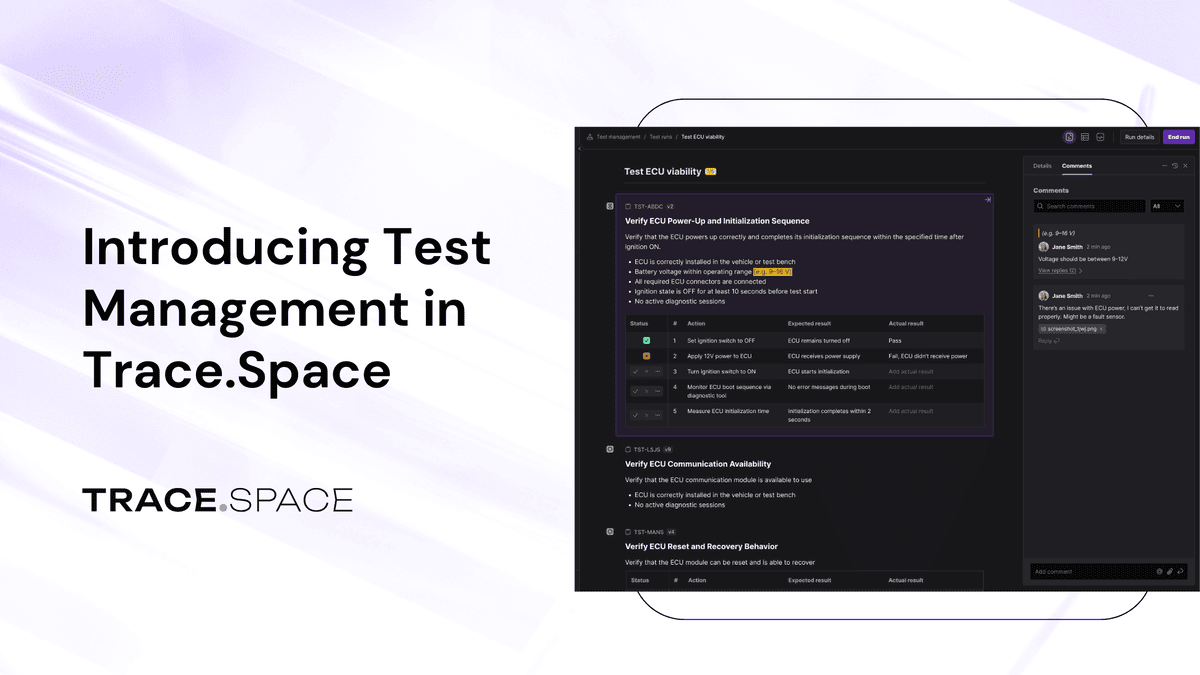
Test Management is now available in Trace.Space. You can define test cases as items, break them into steps, send them to a test run, hand that run to the person who will execute it, and see every result land back on the item that was tested.
Introducing Test Management in Trace.Space
.png)
Engineering
/

Matt Maclaine
Requirements live in one tool, tests in another, and the link between them is maintained by hand. This post argues verification status should be computed instead of typed into a dropdown, and walks through what hand-maintained traceability actually costs: double entry, statusing that goes stale overnight, and stale passes that look exactly like valid ones.
Verification Is Just Like, Your Opinion, Man
Engineering
/

Mikus Krams
Most teams know they need to bring AI into engineering, but have no working reference for what that actually looks like inside a regulated, multi-domain program. Agentic systems engineering is that reference. It is the practice of running engineering work, requirements analysis, traceability, verification, change impact, compliance, through AI agents that operate inside an engineering data model under human review. This article defines the term, separates it from neighboring ideas, and shows what it looks like in the regulated programs where it has the most consequence.
What Is Agentic Systems Engineering

Aerospace programs are too complex for tools built in the 1990s.
Aerospace programs are too complex for tools built in the 1990s.
See what modern traceability looks like.