
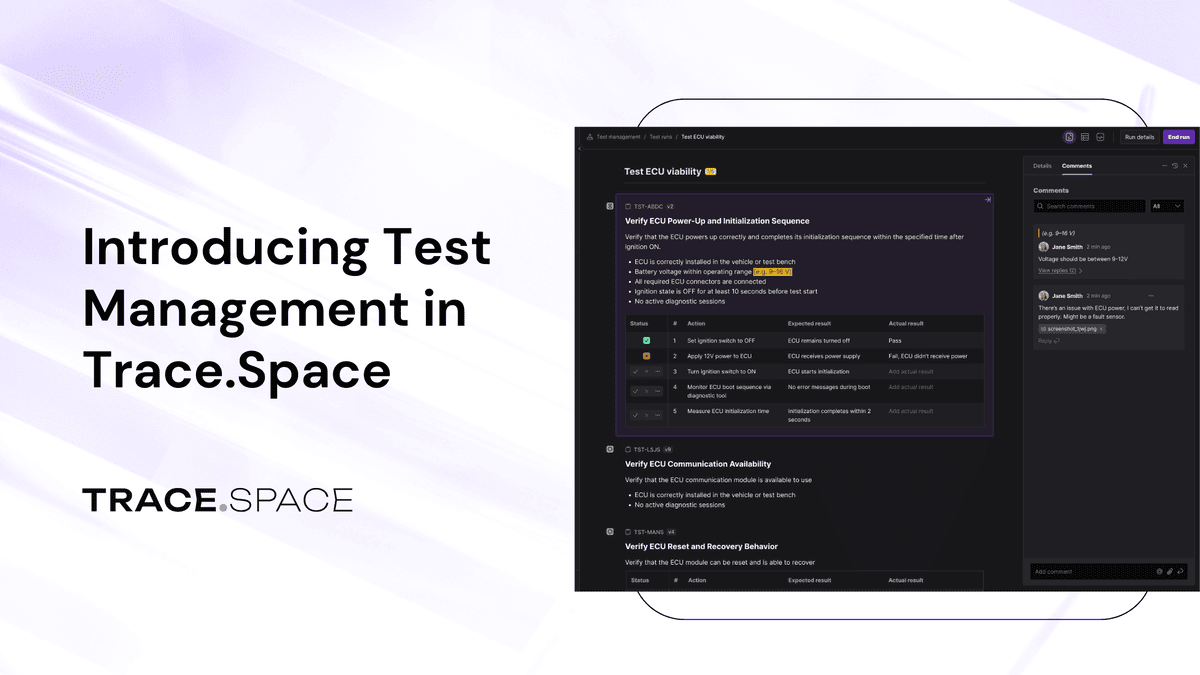
Introducing Test Management in Trace.Space
Product
/

Janis Vavere
/
Aug 5, 2026
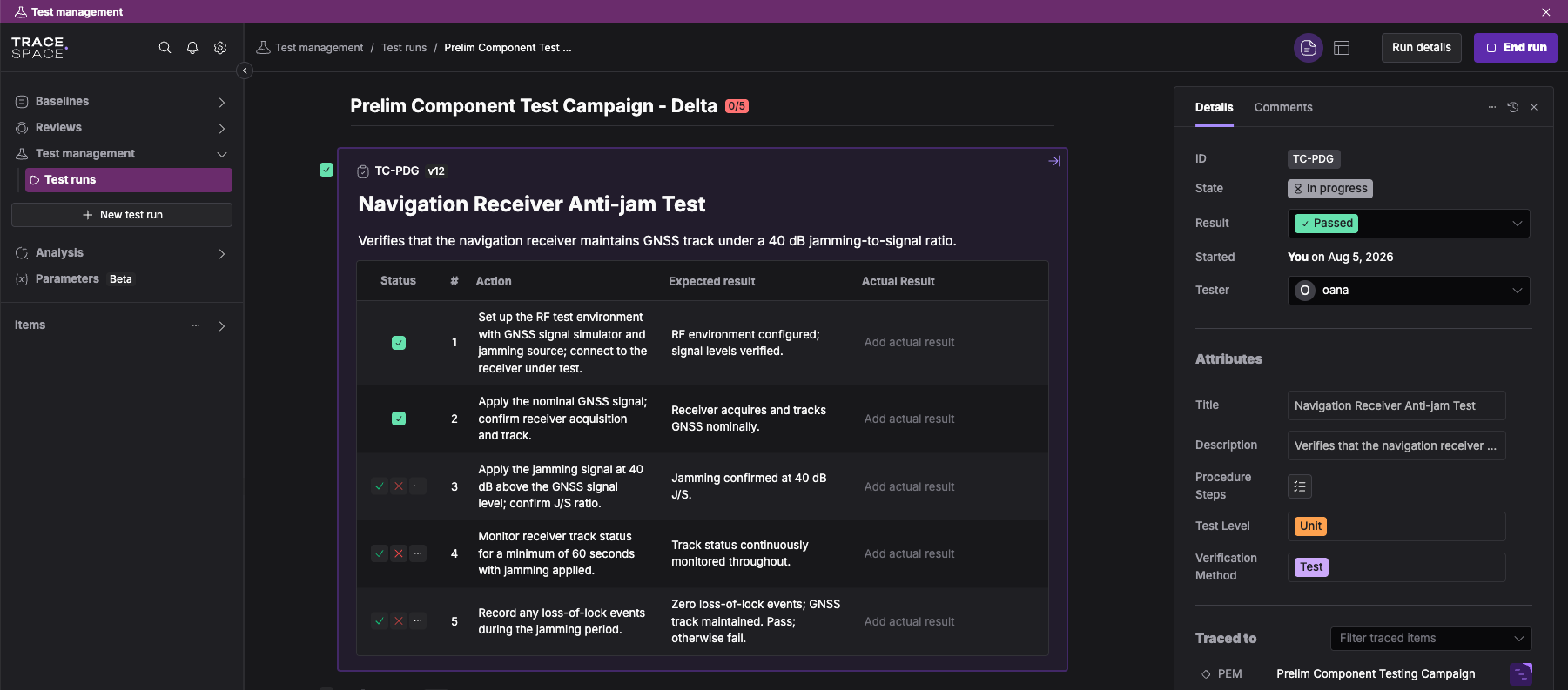
Test Management is now available in Trace.Space. You can define test cases as items, break them into steps, send them to a test run, hand that run to the person who will execute it, and see every result land back on the item that was tested.
Testing finally sits where it has always belonged: next to the requirements it proves, in the same workspace, on the same graph, with the same traceability you already rely on.
Why test management belongs in your requirements tool
A requirement is not finished when it is written. It is finished when something has been executed against it and somebody recorded what happened. For most teams those two halves live in different places: the requirement in a requirements tool, the test in a spreadsheet or a separate test suite. The link between them is a column somebody maintains by hand, and it starts drifting the day it is created.
In Trace.Space, test cases are items in the same workspace as everything else. They trace to requirements the way any item traces to any other item, so the connection between what you asked for and what you actually ran is part of your data model rather than a report somebody assembles before a review.
How it works
The loop is short. Test cases are items in your workspace, so you write them where you already write everything else, with as much or as little procedure as the test deserves. When you are ready to test, you gather what needs checking into a run and hand it to the person who will execute it.
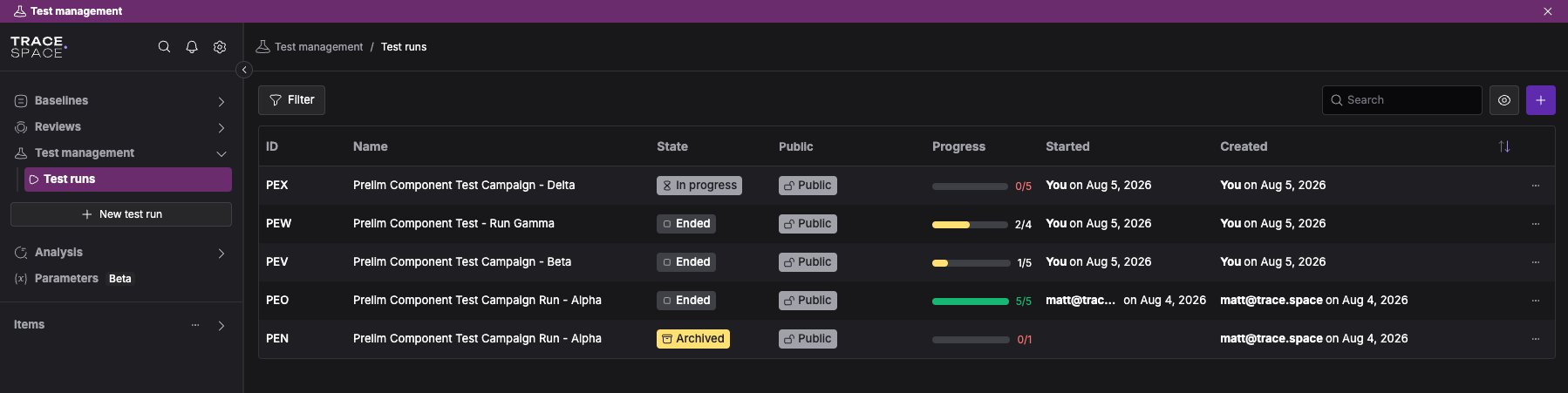
They work through the run, recording what happened and how each item ended up: passed, failed, skipped or cancelled. When the run is closed, every result is attached to the item it was executed against. The walkthrough video below shows the whole thing end to end.
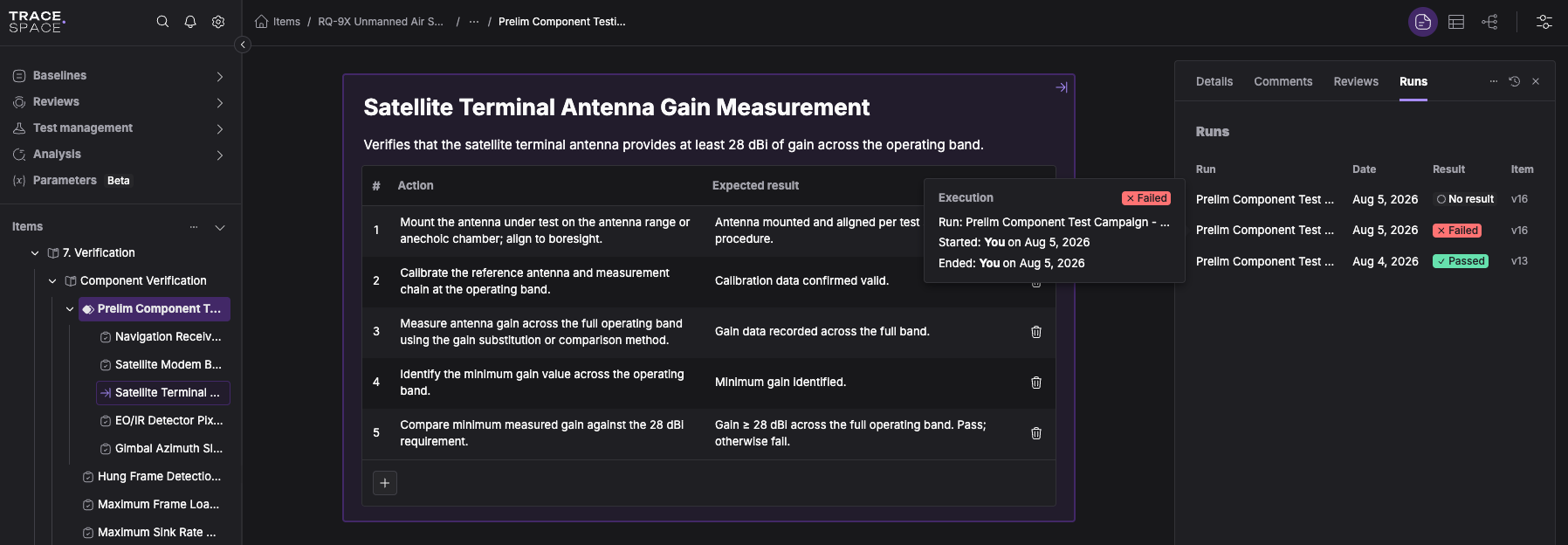
Every execution stays with the item
This is the part that pays off over time. Open the original item and you can see how it has been tested: which runs it was included in, what the result was in each one, and when. It passed here, it failed there, it was skipped in the run before that.
Nobody has to reconstruct that history from a folder of spreadsheets and a chat thread. It is already sitting on the item, in order, ready to show to whoever is asking.
Coverage you can read, not reassemble
Coverage is a question about relationships: which requirements have something executed against them, and which are still waiting. When your tests sit in a separate tool, answering that means exporting both sides and matching them up, and the answer is only as good as the day it was produced.
Because test cases trace to requirements like any other item, and runs attach to the items they were executed against, the answer is already in the graph. You can see which requirements have runs behind them, which ones came back failed, and which have nothing against them yet. That is a view you open, not a report you build.
Secure, traceable, and built for regulated environments
Test Management runs on the same roles and permissions as the rest of your Trace.Space workspace, and Space Agent works inside the permissions of the person it is working for. It can draft test cases from requirements, suggest trace links and point at coverage gaps, but it cannot touch an item that person has no access to, and it does not approve results or decide whether a test has passed. Space Agent recommends, you decide.
Every run records who executed it, when, the results produced and any evidence attached. So when a regulator or a customer quality team asks why a test was performed and what it demonstrates, the chain is something you follow inside the product rather than a document assembled the week before the review. Available wherever your program requires: managed cloud, private cloud, on-premise or fully air-gapped.
Connect it to the test infrastructure you already run
Plenty of your testing is not done by a person clicking through a checklist. It is done by CI pipelines, HIL rigs, simulation jobs and bench equipment that already produce results in their own formats.
Trace.Space is API-first, and Test Management is no exception. Test cases, runs, results and statuses are all available through the same documented API as the rest of the platform, so an automated suite can create a run, push results as they come in and close it out without anyone opening a browser. The manual and the automated results land in the same execution history on the same item, which is the point: your coverage picture should not depend on whether a human or a rig produced the evidence.
Available now
Test Management is available to every Trace.Space workspace today.
Book a demo and we will walk through it against your own requirement structure.
Table of contents
Verification Is Just Like, Your Opinion, Man

Matt Maclaine
/
Jul 30, 2026
What Is Agentic Systems Engineering

Mikus Krams
/
Jun 2, 2026
Trace.Space: the first agentic systems engineering platform
Janis Vavere
/
May 26, 2026
Stop tracking verification by hand
Book a demo and see Trace.Space live. Our team will walk you through it.

Built for Enterprise Engineering Teams
Want to see how Trace.SpaceFits into your stack?Want to see how Trace.Space fits into your stack?
Our team will walk you through enterprise use cases, integrations, and deployment options, tailored to your environment.