
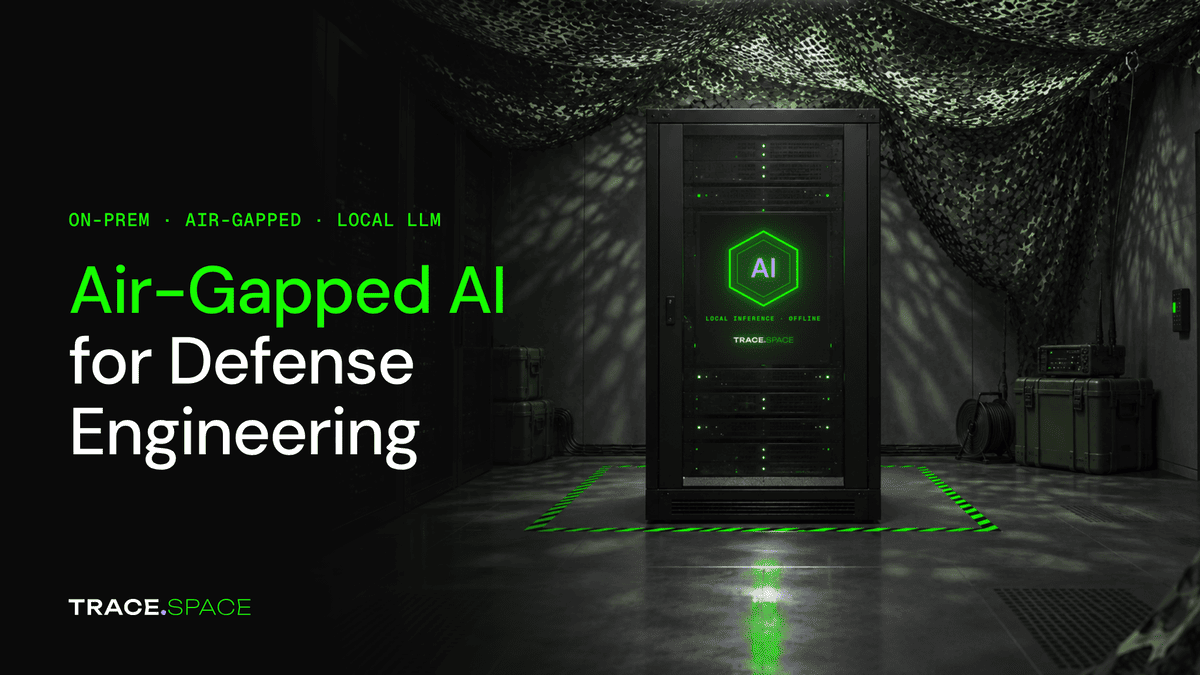
Air-Gapped AI for Defense Engineering: Bring AI to Your Data
Product

Amanda Bagley
Nov 23, 2026


Air-Gapped AI for Defense Engineering: Bring AI to Your Data
You want to bring AI into your engineering workflow. To draft requirements, find gaps in verification coverage, understand change impact, and spend less time manually maintaining traceability. But on a defense program, the first question isn't what the AI can do. It's where the AI runs.
Many sensitive programs require software to operate on-premises or in disconnected environments. Even where cloud deployment is permitted, security reviews, authorization, and procurement can make adding a new AI service a lengthy exercise.
The practical question is how to give engineers AI inside an environment the program already controls.
On-premises isn't necessarily air-gapped
An on-premises platform runs on your infrastructure, but its AI may still send prompts, documents, or embeddings to an external service.
An air-gapped deployment operates without external network connectivity. The platform, models, retrieval services, and other essential dependencies must function locally, without an undisclosed cloud fallback.
Commercial cloud, private cloud, and GovCloud may be appropriate for authorized workloads. ITAR and CUI do not automatically prohibit cloud use, and GovCloud is not synonymous with a disconnected system.
What matters is the program's approved security boundary and whether AI processing stays inside it.
What air-gapped engineering AI needs
A platform should be able to demonstrate four things:
- Local AI inference. An approved LLM or model endpoint runs inside the program's boundary, with no external inference calls.
- A complete offline workflow. Requirements, tests, trace links, document retrieval, authentication, logging, and necessary platform services work without an internet connection.
- Auditable engineering decisions. AI-generated suggestions can be reviewed against source evidence, with changes, baselines, and approvals preserved.
- Deterministic engineering checks. Configurable rules can check broken links, coverage gaps, and parameters outside defined ranges. Those rules are distinct from probabilistic AI suggestions, which remain subject to engineer review.
Software and model updates still require approved transfer and validation procedures. An air gap is a deployment boundary, not an automatic authorization to process classified information.
Bring AI into your security perimeter with Trace.Space
Trace.Space combines AI-native requirements management, traceability, test management, and Space Agent within a connected engineering data model.
Engineering teams can use AI to suggest requirements and trace links, flag missing coverage, and investigate the downstream impact of changes, while deterministic graph rules check defined constraints and relationships.
Deploy Trace.Space on-premises or fully air-gapped, with AI processing inside your environment and support for approved customer-controlled models.
Trace.Space reports SOC 2 Type II auditing and ISO 27001-aligned security controls, alongside role-based access controls and audit logging.
Why Trace.Space AI matters for defense engineering
Defense requirements rarely stay fixed. Mission needs evolve, system configurations change, and a single revision can affect hardware, software, and verification plans across an entire program. Space Agent works with the relationships in the engineering data model, not just an isolated document.
- Turn changing mission needs into traceable requirements. Draft and refine requirements using the context of parent specifications and related engineering data, with engineers reviewing suggestions before acceptance.
- Understand the impact of a change. Identify downstream requirements, linked artifacts, and tests affected by a revision before it creates avoidable rework.
- Manage complexity across system variants. Defense platforms often share a common architecture but have different requirements depending on mission, configuration, or customer. Trace.Space helps engineering teams manage requirements across variants, maintain traceability between shared and variant-specific components, and understand how changes affect different configurations.
- Find verification gaps earlier. Surface missing coverage, broken trace links, and incomplete requirement decomposition before they become issues during a design or milestone review.
- Preserve engineering accountability. Keep AI suggestions subject to human review, with traceability and verification evidence available for critical decisions and audits.
For defense teams, the value of AI isn't simply generating text faster. It's helping engineers manage evolving missions, complex system variants, and continuous design changes without losing control of what was required, which configurations are affected, and what has been verified.
Talk to Trace.Space about on-premises and air-gapped deployment.
Requirements Traceability Matrix: What Hardware Audits Check

Matt Maclaine
Nov 23, 2026
7 Best AI Requirements Management Tools for Hardware Teams (2026)

Janis Vavere
Nov 19, 2026
How Trinity Works: The Agent Harness
Janis Vavere
Nov 11, 2026
Talk to Trace.Space about on-premises and air-gapped deployment.
Air-Gapped AI for Defense Engineering: Bring AI to Your Data


Built for Enterprise Engineering Teams
Want to see how Trace.Space fits into your stack?
Our team will walk you through enterprise use cases, integrations, and deployment options, tailored to your environment.