

Requirements Traceability Matrix: What Hardware Audits Check
Engineering

Matt Maclaine
Nov 23, 2026


A requirements traceability matrix (RTM) is a structured record that maps each requirement backward to its originating stakeholder need, regulation, or hazard, and forward to design elements, implementation artifacts, test cases, and verification results. For hardware teams, a requirements traceability matrix proves that every approved requirement has a known implementation location and a documented verification activity, and that no design or test artifact exists without a requirement behind it.
This explainer defines the concept, shows what a hardware RTM has to connect and what auditors check, walks through the forward and backward chains, and shows where AI agents take over the upkeep a spreadsheet leaves to people.
Key takeaways
- An RTM links each requirement both backward (to its need, hazard, or regulation) and forward (to design, implementation, verification, and the result), so coverage gaps become visible.
- A hardware RTM connects more kinds of items than a software one: hazards and safety levels, design artifacts, hardware items, verification methods and results, and anomalies and waivers.
- DO-254, ISO 26262:2018, and ISO 13485:2016 each expect traceability across requirements, design, implementation, and verification, with rigor scaled by assurance or safety level.
- A spreadsheet RTM breaks the moment the design changes, because the links are manual and the file cannot recompute impact.
- AI agents can keep the links current: they suggest traces, find coverage gaps, and show what a change affects, and an engineer reviews every change.
- Trace.Space keeps requirements, design parameters, and tests in one connected graph, so each matrix you build is a live view that updates itself whenever the graph changes.
What is a requirements traceability matrix?
A requirements traceability matrix is a view of the links between each requirement and everything connected to it: the need, regulation or hazard it came from, the design that satisfies it, the hardware that carries it, and the verification that proves it. In a spreadsheet it is a table someone fills in by hand. In a modern requirements tool it is something you work in: you build a matrix from the items you want to compare, see which links exist and which are missing, and create links in it at scale. Read one way, the matrix runs backward from each requirement to its origin. Read the other way, it runs forward to design, implementation, test cases, and verification results.
The point is coverage. A finished matrix lets you ask a direct question, “Is this requirement implemented and verified, and where?”, and get a direct answer from a single row. For a deeper treatment of the underlying concept, see our explainer on what requirements traceability is.
What does a hardware RTM have to connect?
A hardware RTM is a set of links between kinds of items, and the kinds depend on the program. For safety-critical hardware, these are the links an auditor looks for:
Each link answers a question an auditor will ask. Why does this requirement exist? Where in the schematic or the HDL is it satisfied? Which board carries it? How was it verified, and what was the result? Where a result fell short, which anomaly or waiver records it?
Owners, approvals and change history are information attached to each item. They travel with the items, so the matrix does not carry them as links.
How does forward and backward traceability work?
Forward and backward traceability are the two directions the same links are read, and a useful matrix needs both.
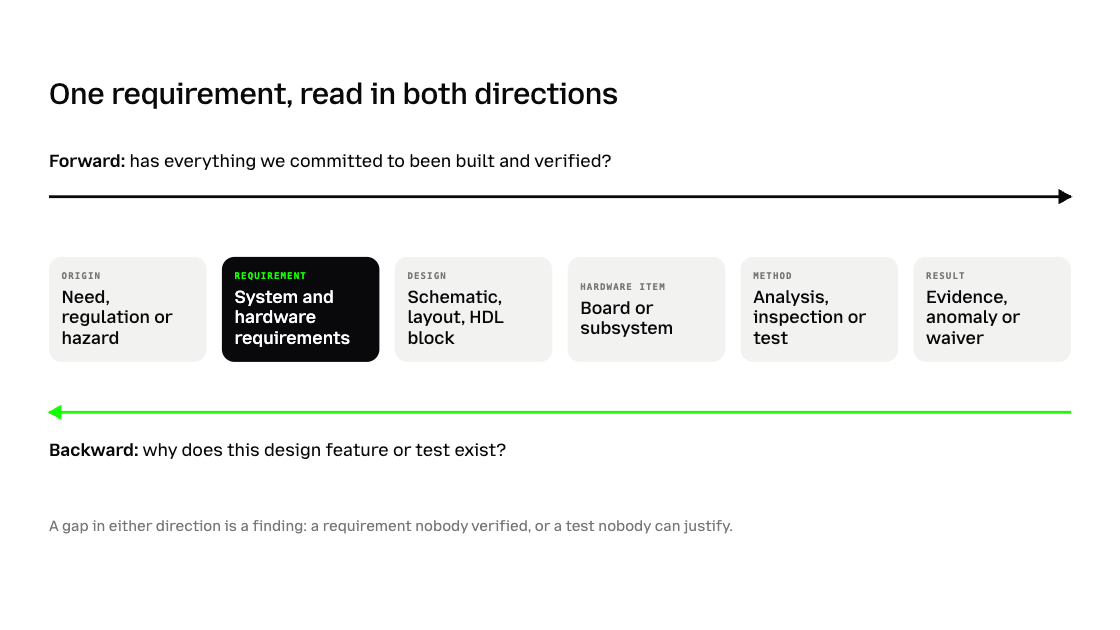
Forward traceability reads down the V-model: requirement to design to implementation to verification result. It answers, “Has everything we committed to been built and tested?” A requirement with no design artifact or no verification procedure is a forward gap.
Backward traceability reads up: verification result to test or inspection to design element to requirement to originating need or hazard. It answers, “Why does this exist, and what need or hazard justifies it?” A test or a board feature with no requirement behind it is a backward gap, and in a regulated program it is either an undocumented requirement or scope that should not be there.
For safety-critical hardware the full forward chain runs stakeholder need, system requirement, hardware requirement, design element, implementation artifact, verification method, and verification result. Each hop is a link the matrix has to hold.
What hardware audits check
An auditor reads a hardware RTM for four claims at once:
- Every approved requirement has an identified implementation location and a verification activity.
- Every safety control is implemented in the product.
- Every verification result traces to the requirement it evaluates.
- No design or test artifact exists without a documented requirement or a justified exception.
The fourth claim is the one teams forget. Forward coverage alone (every requirement has a test) leaves room for orphan design features and tests nobody can justify. A matrix that only runs one direction passes a coverage check and still fails an audit, because the auditor reads it backward.
What do DO-254, ISO 26262, and ISO 13485 require?
DO-254, ISO 26262:2018, and ISO 13485:2016 each require traceability across requirements, design, implementation, and verification, with the rigor scaled to how safety-critical the item is. Name them correctly and the links the matrix needs follow.
- DO-254 applies to airborne electronic hardware and expects traceability across hardware requirements, design, implementation, and verification results. Rigor is especially high for Design Assurance Level A and B hardware. A compliant RTM connects requirements to hardware architecture, detailed design, implementation data, verification procedures, results, and problem reports, so a table of requirements against test cases alone falls short.
- ISO 26262:2018 traces automotive safety goals from hazard analysis through functional and technical safety requirements into hardware and software, with rigor set by Automotive Safety Integrity Level (ASIL). The trace model should carry hazard-analysis IDs, safety goals, functional and technical safety requirements, hardware safety requirements, safety mechanisms, dependent-failure analyses, and verification evidence.
- ISO 13485:2016 requires documented traceability methods in design planning. Medical-device traceability connects user needs, design inputs, risk controls, design outputs, and verification or validation evidence, with each hazard traced to its risk control and the verification of that control’s effectiveness.
For medical-device teams selling in the United States, the FDA’s Quality Management System Regulation now incorporates ISO 13485:2016, with design and development requirements addressed through 21 CFR 820.10(c). Under it, the design history file becomes the design and development file of ISO 13485 clause 7.3.10. Medical-device hardware teams need a design and development file that shows the traceability method and the links among design inputs, risk controls, design outputs, and verification. Our guide to traceability in compliance projects covers the ISO and DO-178C side in more depth.
Where a spreadsheet RTM stops working
A spreadsheet RTM works until the design changes, then it quietly stops being true. The links in Excel are text, not relationships, so when a requirement is revised or a board is re-spun, nothing recomputes. Someone has to find every affected row by hand.
Change impact is the failure case. When a single requirement moves, a hardware team using separate tools for requirements and tests can spend days tracing what else is affected. The matrix cannot answer “what breaks if this changes” because it does not know what connects to what. That is why teams keep returning to spreadsheets and keep getting burned by them: the file is easy to start and impossible to keep honest across a program with thousands of linked items.
The matrix is only as good as the links behind it, and manual links decay.
Where AI agents take over the upkeep
Most of the cost of traceability is upkeep: finding the right item to link, noticing a link that went stale, and working out what a change touches. That is repetitive work over structured data, which is the work AI agents do well.
An agent that can read the requirements, the design items and the tests can do three things for the team:
- Suggest the trace an engineer would otherwise search for, as each requirement or test is written.
- Run the audit checks every day. It lists the requirements no test covers and the tests no requirement justifies, the same forward and backward gaps an auditor looks for.
- Trace a change before it is made, through every design item and test it affects.
Two conditions make this safe in a regulated program. The agent has to work on connected data, because it cannot reason about links that exist only as text in a cell. And an engineer has to review each change, because the auditor will ask who approved the link.
How Trace.Space handles traceability as a graph
In Trace.Space, requirements, design parameters, and tests are connected in one engineering data model, so a trace is a real relationship the system can read in both directions. There is no single matrix to maintain. You build the matrices you need, for example system requirements against tests, or system requirements against subsystem requirements, over items that are already connected, and you create or remove links in bulk from the matrix itself. When a parameter gets a new value, rolling references update while pinned references keep their version.
This is where the agent work described above happens. Space Agent, the AI agent inside Trace.Space, suggests traces, runs the forward and backward coverage checks, and traces the impact of a change on the team’s own requirements data, and engineers review every change it proposes. It works with models from multiple AI providers, including self-hosted models, and Trace.Space does not use customer data to train AI models unless a customer opts in. Trace.Space also has an MCP server, so the AI agents your team already uses can work with the same requirements, traces, and tests.
The platform is built for programs with millions of requirements in one connected graph. Trace.Space is SOC 2 Type II certified and ISO 27001 compliant, and it runs in the cloud, in a private cloud, on premises, or fully air-gapped. See how Space Agent handles coverage and impact tracing.
Scale the links to your assurance level
The standards scale rigor with risk, and the matrix scales the same way. A DAL A or ASIL D item needs every link in the table above. A lower assurance level, or an early prototype, can start with the core chain: the requirement, the design that satisfies it, and the verification that proves it. The other links are added as the assurance level rises.
Set the links up before the spreadsheet breaks. Linking items as they are written is a small daily habit, and an agent can suggest most of the links. Reconstructing them for thousands of items from a spreadsheet, shortly before an audit, is a project of its own.
The matrix shows that the links exist. Whether a verification method is strong enough for its requirement is an engineer’s call, which is why every link an agent suggests goes to an engineer for review.
FAQ
What is the difference between forward and backward traceability?
Forward traceability reads from requirement to design to implementation to verification result, and answers whether everything committed has been built and tested. Backward traceability reads from a verification result back up to the requirement and its originating need or hazard, and answers why something exists. A useful matrix supports both, because each direction catches gaps the other misses.
What should a hardware requirements traceability matrix connect?
Each requirement’s origin (need, regulation or hazard) and safety level; the design that satisfies it; the hardware item that carries it; the verification method, procedure and result; and any anomaly or waiver.
Does an RTM satisfy DO-254 or ISO 26262 on its own?
No. DO-254 and ISO 26262:2018 require traceability as one part of a broader assurance process scaled to the Design Assurance Level or ASIL. The RTM is the evidence that links requirements, design, implementation, and verification, and it sits alongside the hazard analyses, design data, problem reports, and configuration baselines the standard expects.
Can an AI agent maintain a traceability matrix?
Yes, with an engineer reviewing the result. An AI agent can suggest traces, run coverage analysis, and compute change impact on connected data, which removes most of the manual link upkeep. Inside Trace.Space, Space Agent does this on the team’s own requirements data, and engineers review every change it proposes.
See your own requirements, tests, and traces in one connected graph. Request a free trial.
Air-Gapped AI for Defense Engineering: Bring AI to Your Data

Amanda Bagley
Nov 23, 2026
7 Best AI Requirements Management Tools for Hardware Teams (2026)

Janis Vavere
Nov 19, 2026
How Trinity Works: The Agent Harness
Janis Vavere
Nov 11, 2026
See Trace.Space in action
Book a demo and see how it works on your own requirements.



Built for Enterprise Engineering Teams
Want to see how Trace.Space fits into your stack?
Our team will walk you through enterprise use cases, integrations, and deployment options, tailored to your environment.