
7 Best AI Requirements Management Tools for Hardware Teams (2026)
Engineering

Janis Vavere
Nov 19, 2026


The best AI requirements management tool for hardware teams in 2026 is the one where AI understands your whole engineering system, not just the wording of one document. On that test, Trace.Space leads this list: it was built AI-native, keeps requirements, tests, design parameters and variants connected in one graph, and lets its AI agents work across all of it, with an engineer applying every change. Jama Connect, IBM DOORS Next, PTC Codebeamer, Siemens Polarion, Flow Engineering and Perforce Helix ALM follow.
Yes, we built Trace.Space. So instead of asking you to trust the ranking, we show the reasoning: every competitor claim below links to the vendor’s own pages.
Key takeaways
- Legacy suites added AI to a document model. Trace.Space was built AI-native: requirements, tests, parameters and variants sit in one connected graph that AI agents can read and work across, and an engineer applies every change.
- What Jama sells as an AI add-on, from quality checks to test generation and relationship discovery, is built into Trace.Space and included in the license.
- Trace.Space has an MCP server, so the AI agents your team already uses can work with the whole platform.
- Trace.Space runs in the cloud, in a private cloud, on-premises or fully air-gapped, with the same AI everywhere. It is SOC 2 Type II certified and ISO 27001 compliant.
- Moving is a migration, not a rewrite: ReqIF, Word, Excel and API import from DOORS, Jama and Codebeamer, with existing trace links intact.
Best AI requirements management tools at a glance
The table compares the seven tools on what decides a hardware program: how deep the AI goes, how traceability holds up at scale, where the tool can run, and who each one suits best.
How we ranked them
We scored each tool on three criteria, weighted for complex, safety-critical hardware: AI capability depth (does AI understand your whole system, or only suggest text for one item), traceability at scale (requirements, tests, parameters and variants in one model) and deployment flexibility (including on-premises, air-gapped and data residency). Competitor facts come from vendor pages, linked where we cite them; where a vendor does not publish something, we say so.
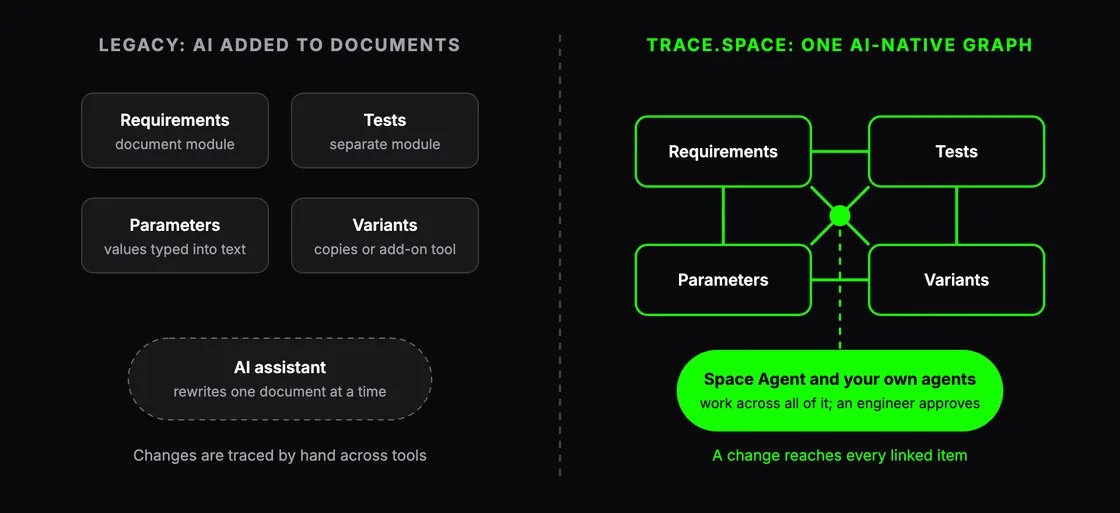
1. Trace.Space: the AI-native platform for hardware engineering
Best for engineering teams building complex products at scale, where thousands of interconnected requirements, design decisions and dependencies need to stay aligned. It is particularly valuable for multidisciplinary teams that need AI agents to reason across the engineering knowledge graph, understand relationships, identify inconsistencies and assess the impact of changes across the entire system.
Trace.Space is newer than the incumbents on this list, and that is the point. It was designed for the way engineering teams now work, with AI agents next to engineers, instead of bolting AI onto a document model from another era.
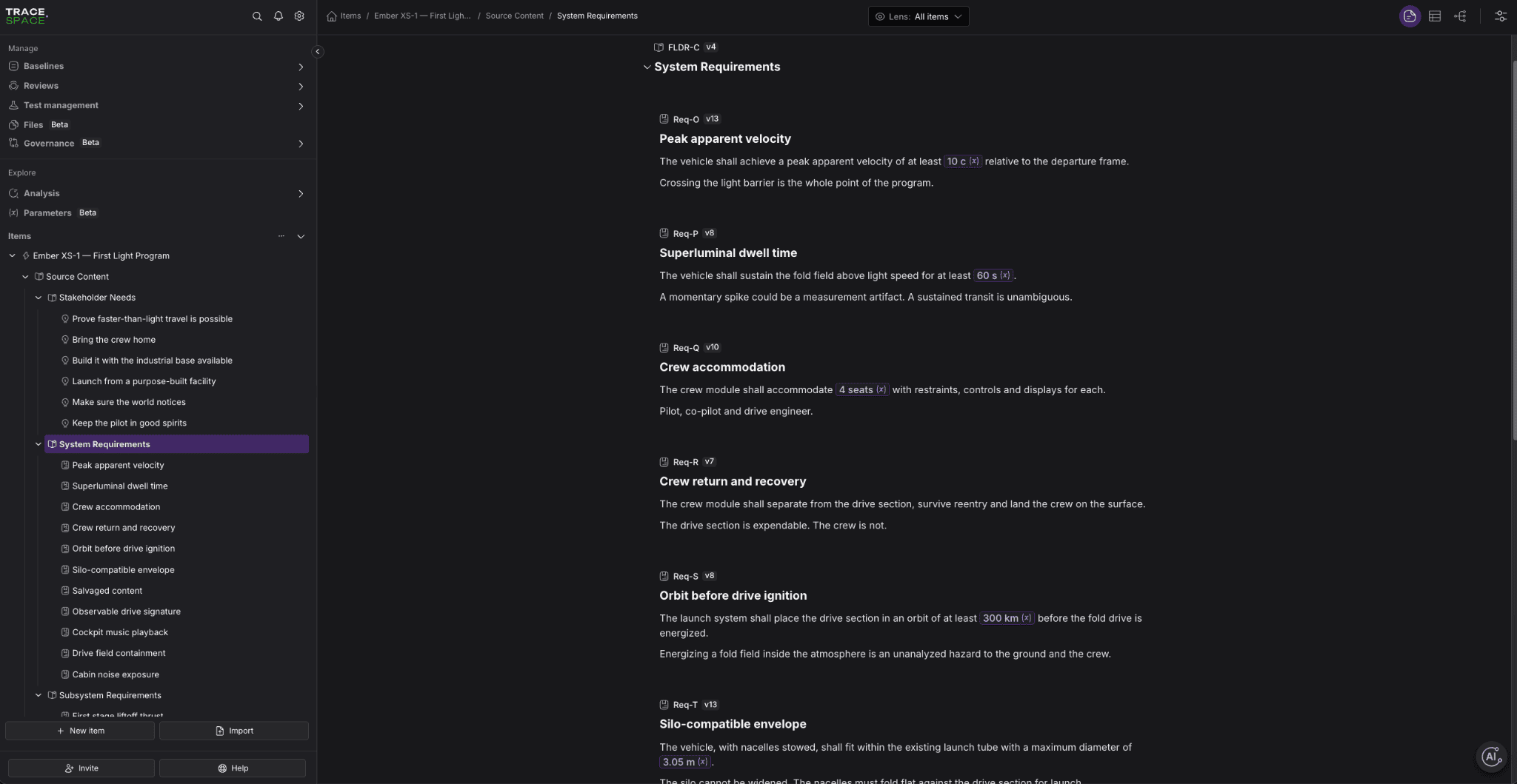
- Trinity keeps the whole system connected. Trinity, the AI harness in Trace.Space, connects requirements to tests, design parameters and product variants, so engineers and AI agents work from the same system. Change a parameter such as max_mass = 12 kg, and the new value automatically propagates to all rolling references, while pinned references retain their version until explicitly updated.
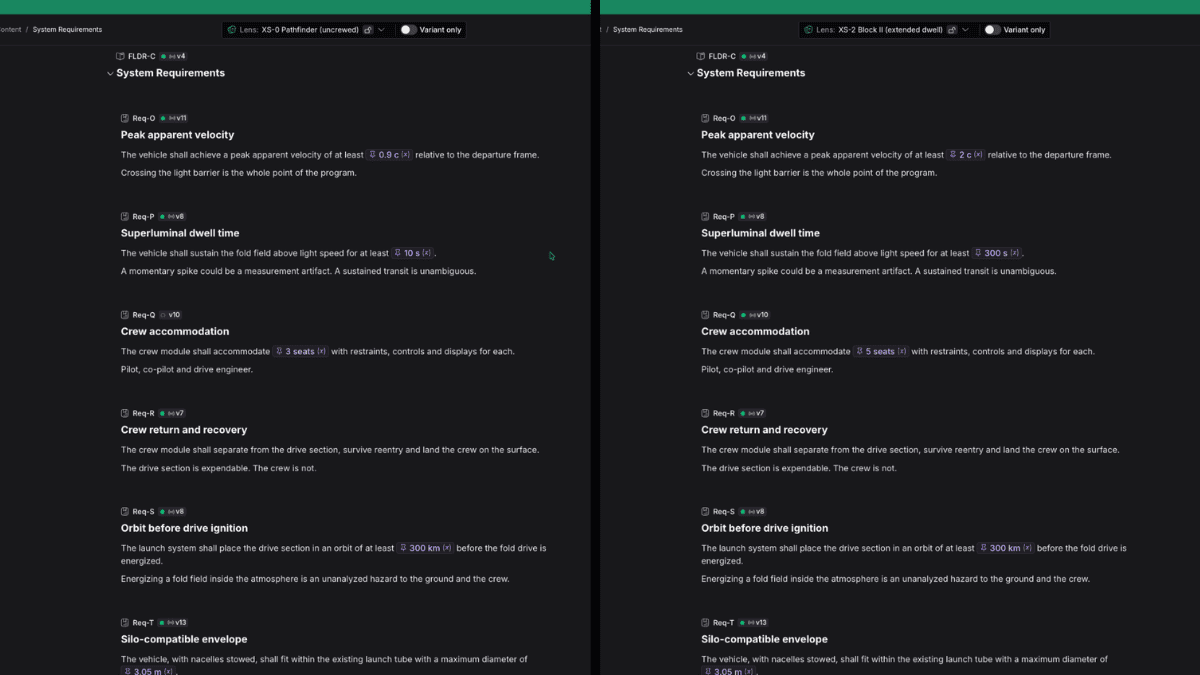
- Variants, natively built in. One set of requirements serves the whole product family. Each variant pins its own versions and values, can be frozen as a release and compared side by side, with no copies to keep in sync.
- Space Agent, AI built into the platform. Space Agent analyzes coverage and change impact, suggests traces, flags broken links and gaps, drafts requirements and tests, and checks requirement quality against INCOSE and EARS rules. Every change arrives as a proposal; the engineer applies it, the change is recorded under their name, and the agent only works within that person’s permissions.
- Open to your own agents. Trace.Space has an MCP server, so the AI agents your team already uses can work with the platform under each user’s permissions. A full API on every editor seat, webhooks and integrations with Jira and Git, among others, connect the rest of the toolchain.
- Your models, your data. Use multiple AI providers or a model hosted inside your network, with your own key and zero data retention. AI is included in the license; with your own model, no AI usage is billed.
- Deployment and security. Cloud, private cloud, on-premises, or fully air-gapped with no external calls, including for AI. SOC 2 Type II certified, ISO 27001 compliant, and GDPR and CCPA ready. See security and compliance.
Go deeper: Trinity, Space Agent and AI-native requirements management.
2. Jama Connect: an established suite with AI as an add-on
Jama Connect is a mature requirements suite for complex, regulated products in automotive, aerospace and medical devices, now with AI sold separately.
- AI capability. Jama Intelligence, announced in October 2026, adds requirement quality analysis, refinement, test case generation, relationship discovery and document parsing as a separately licensed cloud package with an annual credit pool, per Jama Software.
- Live Traceability across requirements, risks and tests.
- Deployment. Cloud and self-hosted, per Jama’s deployment options; self-hosted customers manage their own updates, and only the AI Assistant is planned for them, through a gateway announced for later this year.
Where it falls short: AI is a separate license layered onto an established platform, sold as a cloud package with credits drawn down by capability and user, and self-hosted customers get only the Assistant, later. Public reviewers also describe the interface as unintuitive.
How Trace.Space compares: every Jama Intelligence capability is already in Trace.Space and included in the license, and it goes further: impact analysis from a plain-language question, AI pre-review before reviewers meet, and reasoning over parameters and variants. The same AI runs on-premises against your own model. See Trace.Space vs Jama Connect.
3. IBM DOORS Next: document-centric requirements inside IBM ELM
DOORS Next is used on very large, document-centric programs that run IBM Engineering Lifecycle Management.
- Module-based requirements, baselines and link types for governance-heavy programs.
- AI authoring help. IBM’s Requirements Quality Assistant uses Watson to flag ambiguity and passive voice while authoring.
- Suite integration with IBM ELM test and model management.
Where it falls short: its module structure is organized like a document, even simple customizations need DXL scripting, licensing runs through the ELM portfolio, and the AI helps write individual requirements; it does not work across the whole system.
How Trace.Space compares: modern web collaboration, AI agents that work across traces, tests and parameters, and import from DOORS with existing trace links intact. See Trace.Space vs IBM DOORS.
4. PTC Codebeamer: ALM for V-model and agile in the PTC suite
Codebeamer is an ALM suite for teams in the PTC ecosystem that run V-model and agile delivery side by side.
- Parallel V-model and agile delivery for hardware, firmware and software teams on different cadences.
- Codebeamer AI (January 2026): a Requirement Assistant that checks language against INCOSE rules and suggests rewrites, plus a Test Case Assistant, per PTC.
Where it falls short: the AI assistants focus on writing requirements and test cases, configuring a full ALM suite takes time, and variant management sits in a separate product.
How Trace.Space compares: configured during the evaluation, AI agents that work across the whole engineering graph, and parameters and variants natively built in. See Trace.Space vs PTC Codebeamer.
5. Siemens Polarion: ALM tied to the Siemens ecosystem
Polarion is an ALM suite for companies standardized on Siemens, especially with Teamcenter PLM in place.
- Unified ALM with requirements, test and change management and document-style LiveDocs.
- Compliance templates for ISO 26262, DO-178C and IEC 62304.
- Teamcenter integration within the Siemens portfolio.
Where it falls short: configuration effort is significant, licensing is complex to scope, and outside the Siemens ecosystem its main advantage fades.
How Trace.Space compares: vendor-neutral, AI-native from day one, live in the first session, and import from Polarion. See Trace.Space vs Polarion.
6. Flow Engineering: for early-stage hardware teams
Flow Engineering targets small hardware and robotics teams that want quick setup.
- Requirements and verification for small teams.
- AI agents (Flow v3) monitor changes, run impact analysis and propose fixes. Each fix is made on a separate branch and routed to an engineer, who reviews the branch and approves the merge before anything reaches the baseline; write access for agents is off until an admin opts in, per Flow’s agents page.
- Published pricing tiers limited by number of requirements (500, 5,000, unlimited), with Enterprise by quote and an ITAR option on AWS GovCloud, per Flow’s pricing page.
Where it falls short: tiers capped by requirement count point to smaller programs, its published plans are cloud-based, and every agent change goes through a branch, review and merge cycle before it counts, which adds steps on fast-moving programs.
How Trace.Space compares: item types and trace rules your team defines, AI proposals applied in place by the engineer with no branch to merge, built to scale to millions of requirements and to run anywhere from the cloud to fully air-gapped.
7. Perforce Helix ALM: classic requirements plus test management
Helix ALM puts requirements, test cases and issue tracking in one established tool with traceability between them.
- Three connected modules for requirements, tests and issues, with a traceability matrix.
- Compliance reporting for medical and automotive development.
Where it falls short: native AI is limited in Perforce’s public material, so if AI that understands your engineering data matters, it is not the first tool to shortlist.
How Trace.Space compares: requirements and test management in one graph, with each test run pinned to the version it tested, plus AI agents across all of it.
Best AI requirements management tool by industry
- Robotics and physical AI, including autonomy and automotive: Trace.Space, where variants and parameters handle many configurations from one requirement set, and requirements change as fast as the software does. See automotive and all industries.
- Aerospace and space: Trace.Space, for millions of linked requirements, baselines and deployment up to fully air-gapped. See aerospace.
- Energy, including nuclear, fusion and geothermal: Trace.Space, for long-lived, safety-critical programs where every parameter and test must stay traceable across decades of change. See industries.
- Semiconductors: Trace.Space, where parameters keep specifications and tests in sync across chip variants. See semiconductors.
- Medical devices: Trace.Space, for traceability from requirements to verified tests with reviews and baselines. See medical devices.
When Trace.Space is the clear choice
- You want AI that understands your whole system. Space Agent and your own agents work across requirements, traces, tests, parameters and reviews, and an engineer applies every change.
- Your program is complex and connected. Millions of requirements, tests, parameters and variants in one graph, where a change shows everything it affects the moment it is saved.
- You care about data permissions. Run on-premises or fully air-gapped, or in a hosted region of your choice, with your own AI model and zero data retention by AI providers.
- You are leaving a legacy tool. ReqIF, Word, Excel and API import with existing trace links intact, and a team that runs the migration with yours.
Teams comparing approaches can read AI vs traditional requirements management tools. To see Trace.Space on your own requirements, get a demo or request a free trial.
FAQ
What are the best AI requirements management tools for hardware teams?
Trace.Space leads for teams building complex hardware: AI is built into a connected graph of requirements, tests, parameters and variants, and it runs anywhere from the cloud to fully air-gapped. Jama Connect, IBM DOORS Next, PTC Codebeamer and Siemens Polarion are established suites that have added AI features, Flow Engineering targets early-stage teams, and Perforce Helix ALM covers classic requirements plus test management.
Is a newer requirements tool safe for regulated programs?
Yes. Trace.Space is SOC 2 Type II certified, ISO 27001 compliant, and GDPR and CCPA ready. It keeps every version of every item, supports baselines, formal reviews and test runs, records every AI change under the engineer who applied it, and can run on-premises or fully air-gapped.
Which requirements management tools use AI?
Trace.Space is AI-native: Space Agent is built into the platform, and an MCP server lets the AI agents your team already uses work with Trace.Space too. Jama Connect sells Jama Intelligence as a separately licensed add-on, IBM DOORS Next has a Watson-based Requirements Quality Assistant, PTC Codebeamer AI adds requirement and test case assistants, and Flow Engineering’s agents propose changes on branches that an engineer merges.
Can I move from DOORS, Jama or Codebeamer to Trace.Space?
Yes. Trace.Space imports ReqIF, Word, Excel and CSV, and connects through the API, so content from DOORS, Jama, Codebeamer and Polarion arrives as structured items with existing trace links intact. Our team runs the migration with yours.
Can AI requirements tools run on-premises or air-gapped?
Trace.Space can, with the same AI on cloud and on-premises: it runs fully air-gapped with no external calls, against a model hosted inside your network. Jama Connect can be self-hosted, but Jama Intelligence is a cloud package; a gateway bringing only its Assistant to self-hosted customers is announced for later this year.
How much do AI requirements management tools cost?
Jama Connect, IBM DOORS Next, PTC Codebeamer, Siemens Polarion and Perforce Helix ALM are priced by quote, and Jama’s AI is a separate license with an annual credit pool. Flow Engineering publishes tiers limited by requirement count. In Trace.Space, AI is included in the license, and when you run your own model no AI usage is billed. Request a free trial, or get a demo with your own requirements.
How Trinity Works: The Agent Harness
Janis Vavere
Nov 11, 2026
How Trinity Works: Design Parameters
Janis Vavere
Oct 28, 2026
How Trinity Works: Variants Management
Janis Vavere
Oct 26, 2026
See Trace.Space in action
Book a demo and see how it works on your own requirements.


Built for Enterprise Engineering Teams
Want to see how Trace.Space fits into your stack?
Our team will walk you through enterprise use cases, integrations, and deployment options, tailored to your environment.