

Jama Connect vs Polarion: Which Fits AI-Era Hardware Teams?
Engineering

Janis Vavere
Nov 25, 2026


If you are weighing Jama Connect against Polarion, you already know what both are. What matters is how they differ, and which suits a hardware team that works with AI agents. The main difference is scope: Jama Connect is a requirements suite, and Polarion is Siemens’s application lifecycle management (ALM) suite, with requirements, tests and changes in one platform. On AI they are alike: each vendor sells it as an extra.
That is why this comparison adds a third platform. Trace.Space is an AI-native requirements management platform for hardware teams, with AI included in the license. For a team that works with AI agents it is the better fit, because requirements, tests, design parameters and variants sit in one connected graph an agent can read.
Below, the three are compared on scope, traceability, variants, AI and deployment.
Key takeaways
- The main difference between Jama Connect and Polarion is scope: a requirements suite against an ALM suite, where requirements are written in documents called LiveDocs.
- AI costs extra on both: Jama Intelligence is a separately licensed cloud package, and Polarion Copilot is a paid add-on. In Trace.Space, AI is included in the license.
- Jama’s user guide makes a variant by duplicating a project, and Siemens adds Variant Configurator. In Trace.Space, variants are natively built in: one set of requirements serves the whole product family.
- An AI agent can only follow a link that exists as data. Space Agent, the AI agent inside Trace.Space, works across requirements, tests, design parameters and variants in one graph, and engineers review every change it proposes.
- Trace.Space has an MCP (Model Context Protocol) server, so the AI agents a team already uses can work with the whole platform.
What is the main difference between Jama Connect and Polarion?
The main difference is how much of the product lifecycle each covers.
Jama Connect starts from requirements. Jama Software’s product page calls it an “Intelligent Engineering Management Platform” that runs from requirements management to release, with traceability across requirements, risks and tests.
Polarion starts from the whole lifecycle. Siemens describes it as the ALM standard for large-scale, compliance-heavy product development: a browser-based solution to define, build, test and manage complex software systems. Requirements are written in LiveDocs, which Siemens describes as online structured specification documents.
For comparison, Trace.Space keeps requirements and test management in one graph with design parameters and variants, so engineers and AI agents work from the same data.
How is traceability managed?
Jama’s name for its approach is Live Traceability. Its product page describes the live state of product development, across all disciplines and branches, as continuously maintained. Siemens says Polarion’s traceability is easy to implement and is backed by automatic change control of every requirement.
On the other hand, Trace.Space makes traceability easier to create, manage, and maintain. Engineers can link items in just two clicks, create relationships in bulk using traceability matrices, or use Space Agent to suggest relevant traces and identify gaps or broken links. All relationships are bidirectional and stored in a unified graph, alongside full version history, baselines, and formal reviews.
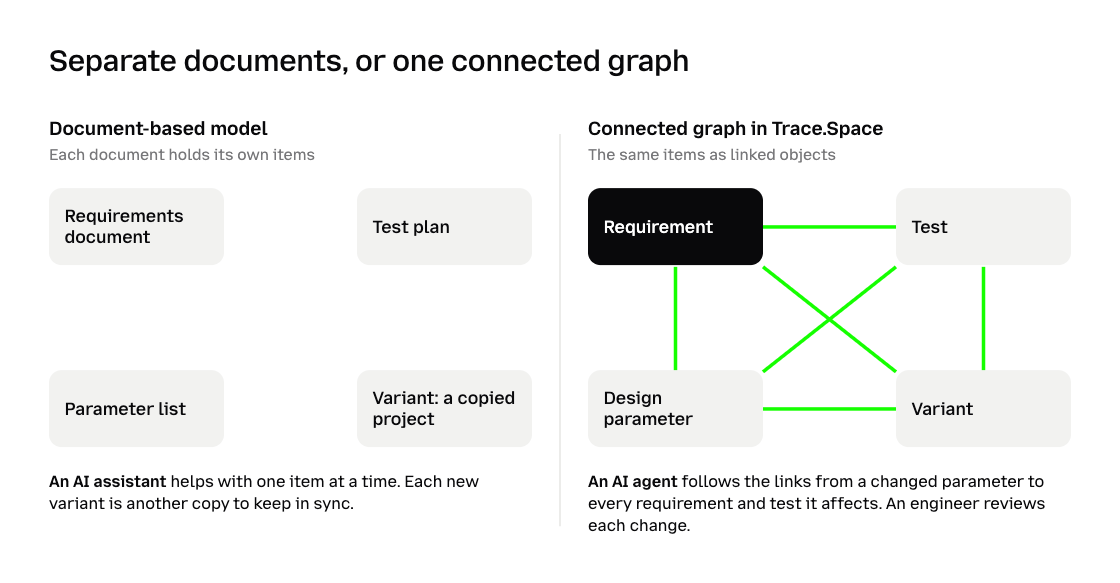
The model matters once AI agents join the team: an agent can only follow a link that exists as data. In a graph, a sensor requirement, the rig test that verifies it and the parameter that sets its range form one path an agent can read.
How are variants and product lines managed?
Jama’s user guide lists branching a project to create a variant product: the project is duplicated, and differences between the copies are monitored.
Siemens offers Polarion Variant Configurator, which it describes as a feature within Polarion ALM where teams define and manage features in feature models.
In Trace.Space, variants are natively built in. One set of requirements serves the whole product family. Each variant pins its own versions and values, can be frozen as a release and compared side by side, and there are no copies to keep in sync.
Design parameters follow the same logic. A design parameter is a named value such as max_mass = 12 kg, defined once and referenced in requirements and tests. Change it, and the new value reaches every rolling reference, while pinned references keep their version until someone updates them. Jama’s guidance, in a support article, is to create a separate Parameter item type, link it into requirements and tests, and update values through the REST API. Siemens’s Polarion pages do not mention design parameters.
What AI and agent capabilities are available?
Jama sells its AI as Jama Intelligence, a separately licensed cloud package paid from an annual pool of shared credits. It covers an Assistant that proposes changes for confirmation, requirement quality analysis, refinement, test case generation and relationship discovery. Jama’s announcement says teams can connect the AI tools they already use through MCP, the protocol that connects AI applications to external systems.
Siemens sells Polarion Copilot as a paid add-on for Polarion X, the cloud version of Polarion, according to its release announcement. Its tools include validating work item descriptions against the rules of INCOSE, the International Council on Systems Engineering, and checking linked work items for consistency. Siemens’s Polarion product and AI pages do not mention AI agents or an MCP server.
In Trace.Space, all of this is built in and included in the license. Space Agent analyzes coverage and change impact, suggests traces and flags duplicate requirements through those suggestions, flags broken links and gaps, drafts requirements and tests, and checks requirement quality against INCOSE rules and the EARS (Easy Approach to Requirements Syntax) sentence patterns. Because design parameters and variants are in the same graph, it can answer a question such as “if we raise this value on one variant, what does it affect?” Every change arrives as a proposal that an engineer reviews and applies.
Space Agent works with multiple AI providers or with a model hosted inside your network. Through the Trace.Space MCP server, the AI agents your team already uses can work with the whole platform under each user’s permissions.
What deployment options are available?
Jama Connect comes as a cloud service or self-hosted, according to Jama’s deployment page. Jama Intelligence is a cloud package, and Jama has announced a gateway that brings only its Assistant to self-hosted environments.
Siemens offers Polarion on premises or in the cloud as Polarion X. Copilot is listed for Polarion X plans, and Siemens’s Polarion pages do not say whether on-premises installations get it.
Trace.Space runs in the cloud, in a private cloud, on premises or fully air-gapped, with the same AI in each. An air-gapped installation makes no external calls, including for AI. Trace.Space is SOC 2 Type II certified and ISO 27001 compliant.
Jama Connect, Polarion and Trace.Space side by side
Moving from Jama Connect or Polarion
Trace.Space imports Excel, CSV, Word and ReqIF files and connects through its API, so content from Jama Connect or Polarion arrives as structured items with existing trace links intact. The Trace.Space team runs the migration together with yours.
The move can be phased: where the legacy tool has API access, Trace.Space can synchronize data with it during the move. See Trace.Space vs Jama Connect and Trace.Space vs Polarion for the steps.
FAQ
How do Jama Connect and Polarion differ for hardware teams?
Jama Connect is a requirements suite, and Polarion is Siemens’s application lifecycle management suite, where requirements are written in LiveDocs. Both vendors sell AI separately. Trace.Space includes AI in the license.
Which handles variants: Jama Connect, Polarion or Trace.Space?
Jama’s user guide describes duplicating a project to create a variant product, and Siemens offers Polarion Variant Configurator. In Trace.Space variants are natively built in, with one set of requirements for the whole product family.
Can a team move from Jama Connect or Polarion to Trace.Space?
Yes. Trace.Space imports Excel, CSV, Word and ReqIF files, and existing trace links arrive intact. The migration can be phased.
See your own requirements, design parameters and variants in one connected graph. Request a free trial.
DO-178C Requirements Traceability: What Each DAL Must Show

Matt Maclaine
Nov 26, 2026
Robotics Requirements Management: What Physical AI Misses
Matt Maclaine
Nov 25, 2026
Air-Gapped AI for Defense Engineering: Bring AI to Your Data

Amanda Bagley
Nov 23, 2026
See Trace.Space in action
Book a demo and see how it works on your own requirements.


Built for Enterprise Engineering Teams
Want to see how Trace.Space fits into your stack?
Our team will walk you through enterprise use cases, integrations, and deployment options, tailored to your environment.