DO-178C Requirements Traceability: What Each DAL Must Show
Engineering

Matt Maclaine
Nov 26, 2026
A flight control computer, an actuator controller or a sensor unit cannot go on a certified aircraft until the certification authority accepts the software inside it. DO-178C is the document the FAA and EASA recognize for that, and part of the evidence it asks for is traceability: a documented, two-way link from each system requirement given to the software, through the software requirements and the code, to the tests that verify it.
How much of that chain you have to show depends on the software level, also called the design assurance level (DAL), which runs from A to E according to what a software failure could do to the aircraft. Level A shows the whole chain with the strictest testing of the code, level D shows a shorter chain, and level E shows nothing under DO-178C.
This article covers what DO-178C is, what each level has to show, derived requirements, where the chain breaks, and how it connects to the system and hardware processes.
Key takeaways
- Find out your unit’s software level first. Also called the design assurance level (DAL), it runs from A to E, comes from what a software failure could do to the aircraft, and decides how deep the trace chain goes: to tested software requirements at level D, into the source code from level C.
- A derived requirement is one the software team adds that no system requirement asked for. Send it to the safety assessment of the aircraft system the unit belongs to, because it can change how that system fails.
- DO-178C covers only the software. System requirements come from the ARP4754A process and electronic hardware follows DO-254, so one system requirement can end in two chains.
- AI agents can check both directions of the chain every day. In Trace.Space, an AI-native requirements management platform for hardware teams, engineers review every change Space Agent proposes.
What is DO-178C, and what does it ask you to trace?
DO-178C, Software Considerations in Airborne Systems and Equipment Certification, tells a company building airborne equipment how to show that its software works, with a level of confidence that matches the harm a failure could cause. RTCA publishes it, and EUROCAE issues it as ED-12C.
It matters because of who accepts it. The FAA recognizes DO-178C in AC 20-115D as an acceptable means, but not the only means, of showing compliance for the software aspects of airborne systems and equipment, and EASA describes its AMC 20-115D as technically identical.
Traceability is part of the evidence the document expects. It is kept as trace data and runs in both directions between these items:
- System requirements given (allocated) to software and high-level requirements, which say what the software must do
- High-level requirements and low-level requirements, the detail the code is written from
- Low-level requirements and source code
- Requirements, the test cases and procedures that verify them, and the verification results
Read forward, the trace chain shows that each system requirement was built and verified. Read backward, it shows a requirement behind all code and every test.
For a hardware team, the top of this chain is your own work. On a flap actuator control unit, a system requirement for the maximum time to detect a jammed actuator is split between the position sensor electronics and the software, and the software chain starts there.
What does each software level (DAL A to E) have to show?
The safety assessment of the aircraft system looks at the worst failure the software could contribute to and assigns the software level from it. The level sets how many objectives apply: DO-178C lists 71 for level A, 69 for level B and 26 for level D.
The amount of code the tests must exercise grows with the level, up to modified condition/decision coverage (MC/DC) at level A, where each condition in a decision is shown to affect the outcome on its own. So does independence: more objectives are verified by someone who did not develop the item.
What does the trace chain look like?
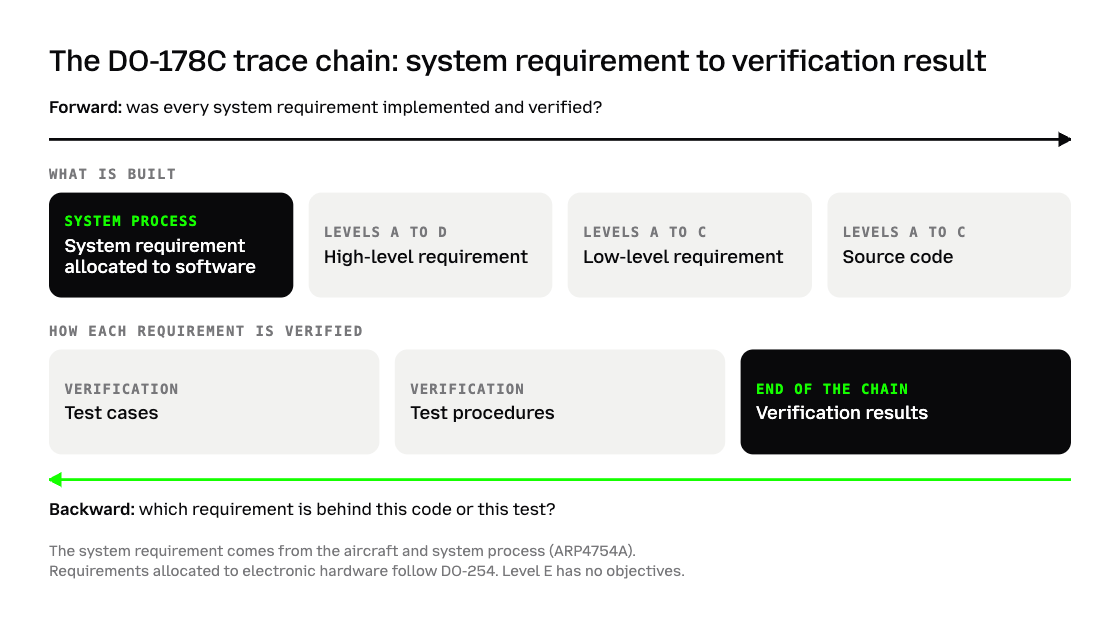
The figure shows the chain for levels A to C. At level D it is shorter: system requirements given to software, high-level requirements, and the tests that cover them. Scale the chain to your level, and start linking when the first requirement is written.
What is a derived requirement, and what do you do with it?
In DO-178C, a derived requirement is one the software team adds during development that no higher-level requirement asked for, so it has no parent to trace to. A debounce time on a weight-on-wheels sensor input is a typical case: the short wait before the software accepts that the aircraft is on the ground. The system specification does not ask for it, and the software needs it.
DO-178C requires derived requirements to be provided to the system processes, including the system safety assessment. Here that is the landing gear system’s safety assessment, because a decision made in software can change how that system behaves when something fails.
In the trace data, a derived requirement looks like an orphan unless it is marked. Give it a flag, a written rationale, and a link to the safety assessment item that reviewed it.
Where does traceability usually break?
It tends to break in three places:
- Late changes. A system requirement changes after tests have run, and nobody can say which code and test results are now out of date.
- Derived requirements without rationale. They pile up during design and never reach the safety assessment.
- Variants traced as copies. A control unit that flies on two aircraft models gets two copied requirement sets, and a fix in one never reaches the other.
All three come down to checks an AI agent can run every day: requirements with no test, tests with no requirement, and every item downstream of a change, listed for an engineer to review.
How does DO-178C fit with ARP4754A and DO-254?
ARP4754A, the SAE guideline for developing civil aircraft and systems, is recognized by the FAA in AC 20-174. System requirements are allocated to hardware and software items there, and each item receives its development assurance level, which for a software item is the software level.
DO-254 (ED-80 at EUROCAE), recognized in AC 20-152A, is the counterpart for airborne electronic hardware such as FPGAs and ASICs. Hardware requirements there are traceable to and from the upper-level requirements allocated to the device.
One system requirement can therefore end in two chains, one in software and one in hardware, and derived requirements from both return to the system process. See also traceability in compliance projects and the aerospace page.
How does Trace.Space keep the trace chain up to date?
Trace.Space keeps requirements, design parameters, variants and tests in one connected graph, so the chain above is stored as two-way links that engineers and AI agents can both follow.
Build custom traceability matrices to visualize relationships, identify gaps, and create links in bulk directly from the matrix.
Trace.Space also provides integrated test management, where each test run references the specific version of the item being tested, ensuring results remain tied to what was actually verified.
Before a late change lands, impact analysis shows every affected item, linked tests included. A design parameter such as the jam detection time is defined once: a changed value reaches every rolling reference, and pinned references keep their version until someone updates them. Variants are natively built in, so two aircraft models share one requirement set.
Space Agent, the AI agent inside Trace.Space, suggests traces, flags broken links and coverage gaps, and analyzes change impact. Engineers review every change it proposes, and each applied change is recorded under the engineer’s name. Trace.Space has an MCP server, so the AI agents your team already uses can work with the same requirements, traces and tests.
FAQ
Does DO-178C require bidirectional traceability?
Yes. Down, each requirement given to software must lead to what implements and verifies it, so nothing is left out. Up, each item must lead back to a parent, so nothing is added without a reason; derived requirements go to the safety assessment.
Is a DAL the same as a software level?
For software, yes. DO-178C says software level. ARP4754A assigns each item a development assurance level, which for a software item is its software level, so many teams say DAL for both.
Does a traceability tool need qualification under DO-330?
That depends on how you use it. DO-178C calls for tool qualification when a tool eliminates, reduces or automates a process and its output is not verified. Settle it in planning with your certification authority.
See your own system requirements, software and hardware requirements, and tests in one connected graph. Request a free trial.
Jama Connect vs Polarion: Which Fits AI-Era Hardware Teams?

Janis Vavere
Nov 25, 2026
Robotics Requirements Management: What Physical AI Misses
Matt Maclaine
Nov 25, 2026
Air-Gapped AI for Defense Engineering: Bring AI to Your Data

Amanda Bagley
Nov 23, 2026
See Trace.Space in action
Book a demo and see how it works on your own requirements.

Built for Enterprise Engineering Teams
Want to see how Trace.Space fits into your stack?
Our team will walk you through enterprise use cases, integrations, and deployment options, tailored to your environment.