
Robotics Requirements Management: What Physical AI Misses
Engineering

Matt Maclaine
Nov 25, 2026


A robot never stays the way you tested it. A heavier battery, a new gripper or a retrained policy can undo a requirement or a test result someone signed off months ago. Robotics requirements management is how you keep track: you write down what the robot must do, link each requirement to the hardware values and tests it depends on, and keep those links true as the design changes. The part physical AI teams miss is learned behavior: a policy trained from data still needs a written requirement, a trace to the hardware it depends on, and test evidence a reviewer can follow.
This article covers the four gaps robot teams leave open, the safety standards that apply, and how AI agents and Trace.Space, an AI-native requirements management platform for hardware teams, help close them.
Key takeaways
- Write the requirement for a learned behavior before you retrain the policy. Without a stated success rate, object set and gripper, a higher simulation score is not a pass.
- Four gaps recur: learned behavior with no requirement, variants handled as copies, design parameters that drift, and test results that stop applying.
- A passed test is evidence only for the configuration it ran on. After a new gripper, mass or policy, it has to be rerun or confirmed.
- Copied requirements are where safety fixes get lost. Write them once and give each robot generation its own parameter values.
- AI agents can find coverage gaps, trace change impact, suggest links and check requirement wording, with engineers reviewing every change.
What does robotics requirements management cover?
A robot is three kinds of engineering in one product: hardware, embedded software, and behavior, which includes policies learned from data. Requirements management covers all three and the dependencies between them.
Learned behavior is the part that usually gets left out. A trained policy has no line of code a reviewer can point to, so nobody writes a requirement for it.
How are robot requirements different from software requirements?
- Physical constraints. A stopping-distance requirement depends on platform mass, brake torque and sensing latency, so a hardware change can break a requirement nobody edited.
- Real-world interaction. No bench reproduces the floors, loads and people a robot meets, so evidence comes from simulation, test rigs and field trials.
- Several hardware generations at once. One software update lands on generation 1, 2 and 3, and each has its own parameters, requirements and test history.
What physical AI teams miss
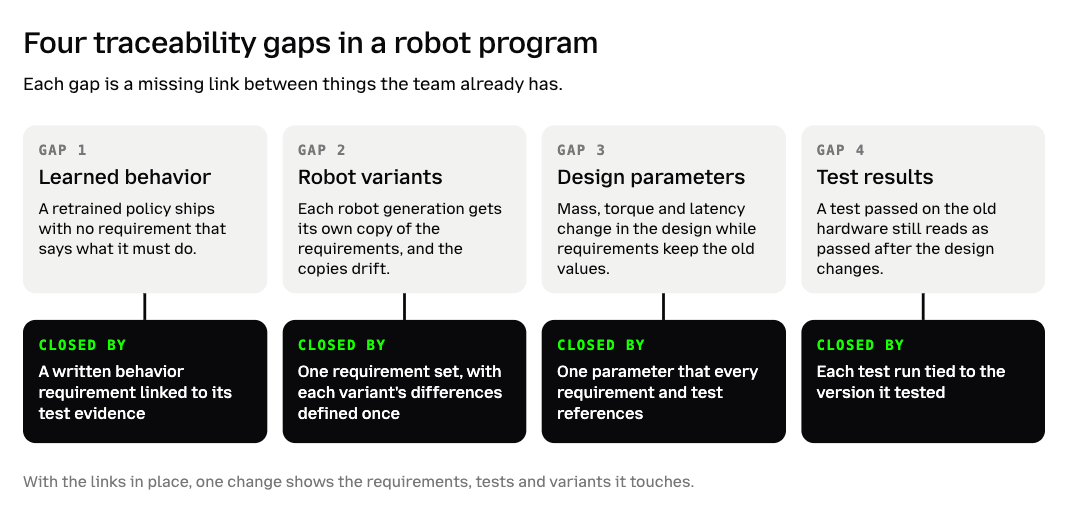
Learned behavior with no requirement. A retrained grasp policy ships because its success rate went up in simulation. No requirement says what rate is needed, on which objects, with which gripper.
Variants handled as copies. The generation 2 arm’s requirements are copied from generation 1. Later a safety requirement is corrected in one copy and missed in the other.
Design parameters that drift. A payload upgrade raises arm mass from 11 kg to 12.5 kg. The stopping-distance requirement and the joint torque budget still quote 11 kg.
Test results that stop applying. A force-limit test passed on the rig with the old gripper. The gripper changes, and the record still says “passed”.
How do you connect behavior, design parameters and tests?
Each gap is a missing link between things that already exist, and a document cannot hold it: a number typed into a specification is only text.
Link “the robot shall stop within 0.5 m of a detected person” to the mass, brake torque and latency it assumes and to the tests that verify it. Then fit a heavier battery, and requirements traceability shows which requirements quote that mass, which tests need a rerun, and which variants break.
How do you manage robot variants and fleets?
Define the shared requirements once and state the differences explicitly. The stopping requirement is the same sentence for every platform, with a different mass and brake torque on each.
Suppose the stopping test passed on the 40 kg indoor platform. The 90 kg outdoor platform, added as a variant, reads the same requirement with its own values, and the indoor result does not carry over: the outdoor robot shows a safety requirement with no passing test. The team runs the test, measures a stop at 0.7 m against the 0.5 m limit, and fits stronger brakes before that robot ships.
For a fleet, freeze each shipped configuration with its requirement versions, parameter values and test results, so you know what each hardware generation was verified against.
Which safety standards apply to robots?
A safety assessment asks for the same links: each safety requirement needs an owner, a link to the design that implements it, and test evidence. The first three standards below are each written for a kind of robot. IEC 61508 is the generic one.
For learned behavior, the technical report ISO/IEC TR 5469 describes using non-AI safety functions to keep AI-controlled equipment safe. On a robot, a learned policy could plan the motion while a conventional safety function limits speed and force.
Where AI agents help
Keeping these links current is repetitive work that AI agents do well. On connected data, with an engineer reviewing every change, an agent can:
- Find coverage gaps: the behavior requirements with no test behind them.
- Trace change impact: every requirement, test and variant a new torque limit touches.
- Suggest trace links: the requirements a new gripper test verifies.
- Check requirement quality: “the robot shall grasp reliably” has no number, condition or test method.
What Trace.Space does for a robotics team
Trinity, the AI harness in Trace.Space, connects requirements, design parameters, tests and product configurations in one graph. For the four gaps, that means:
- Learned behavior. The grasp requirement, with its success rate, objects and gripper, traces to its test cases. Test cases live in the same workspace as requirements, and simulation jobs and test rigs can post results through the API. After a retrain, you see which behavior requirements have runs behind them, which failed and which have none yet.
- Design parameters. Arm mass is a parameter, a named value with a unit that requirements and tests reference. Change 11 kg to 12.5 kg and you get the list of everything that uses it. A changed value reaches every rolling reference, and pinned references keep their version until someone updates them, so a requirement verified at 11 kg still reads 11 kg until an engineer confirms 12.5 kg.
- Variants. Variants are natively built in. One set of requirements serves the robot family and each generation pins its own versions and values, so no copy falls behind. Freeze a generation at release and you keep the record of what shipped.
- Test results. Each test run is pinned to the version it tested, and results are recorded per variant, so a pass says which version and which robot generation it belongs to. When a parameter or requirement changes, impact analysis lists the tests linked to it, so the team knows which ones to run again.
Robots in the field span several hardware generations and software releases at once. Serve Robotics describes what that takes:
“The hard part isn’t any single requirement - it’s keeping requirements, tests, and hardware configurations connected across all of those versions at once. That’s the structure we’re building in Trace.Space.”
Jackie Song, Senior Systems Engineer, Serve Robotics
Space Agent, the AI agent inside Trace.Space, does this agent work on your data. Ask it what a heavier battery affects and it follows the parameter through the requirements, tests and variants that use it. Engineers review every change it proposes. Trace.Space has an MCP (Model Context Protocol) server, so the AI agents your team already uses can work with the whole platform under each user’s permissions.
Trace.Space runs in the cloud, in a private cloud, on premises or air-gapped. Scale it to your level: start with behavior requirements and their tests, then add variants.
FAQ
Do learned behaviors need written requirements?
Yes. A reviewer can only judge a learned behavior against a written requirement: what the robot shall do, in which conditions, within which limits. Scenario tests, simulation runs and trials on the physical robot are its evidence.
How do you trace requirements across robot variants?
Keep one set of requirements and define each variant’s differences as parameter values and item versions, so nothing is copied. Record test results per variant, so a new variant shows every requirement it has no passing test for.
Which safety standards apply to a mobile or collaborative robot?
A collaborative industrial arm is covered by ISO 10218-1 and ISO 10218-2, with ISO/TS 15066 for collaborative operation. Driverless industrial trucks, a category whose examples include autonomous mobile robots, are covered by ISO 3691-4. Your safety engineers and certification body confirm the final list.
See your robot’s requirements, parameters, tests and variants in one connected graph. Request a free trial.
DO-178C Requirements Traceability: What Each DAL Must Show
Matt Maclaine
Nov 26, 2026
Jama Connect vs Polarion: Which Fits AI-Era Hardware Teams?

Janis Vavere
Nov 25, 2026
Air-Gapped AI for Defense Engineering: Bring AI to Your Data

Amanda Bagley
Nov 23, 2026
See Trace.Space in action
Book a demo and see how it works on your own requirements.



Built for Enterprise Engineering Teams
Want to see how Trace.Space fits into your stack?
Our team will walk you through enterprise use cases, integrations, and deployment options, tailored to your environment.