
ISO 26262 Requirements Traceability: What Each ASIL Needs
Engineering

Janis Vavere
Nov 23, 2026


If your team builds electronics for a road vehicle, such as a brake controller or a battery management system, you will be asked to show that a fault in it will not put people in danger. ISO 26262 is the international standard for that. It covers functional safety: keeping a vehicle safe when its electrical and electronic systems malfunction.
Much of the evidence it asks for is requirements traceability: every safety requirement can be followed up to the hazard it came from, down to the design that implements it, and across to the verification that proves it. That chain is the same at every Automotive Safety Integrity Level (ASIL), the standard’s risk rating from A, the lowest, to D, the highest. What grows with the ASIL is the evidence around it: stricter methods, more independent reviews and tighter hardware metric targets.
This article covers that chain, what changes with the ASIL, how Automotive SPICE fits in, where the chain breaks, and how AI agents keep it current.
Key takeaways
- Build three links for every safety requirement: up to its hazard, down to its design and across to its verification. An assessor will follow each one.
- Plan the same chain at ASIL A as at ASIL D. A higher ASIL adds evidence around the chain and leaves the links unchanged.
- Automotive SPICE (ASPICE), the automotive industry’s process assessment model, asks for traceability in both directions on every requirement, so one set of links can serve ISO 26262 and ASPICE.
- AI agents can do the upkeep: they find safety requirements with no test and tests with no requirement, and an engineer reviews every change.
What traceability does ISO 26262 require?
Safety work under ISO 26262 starts with a hazard analysis and risk assessment: the team identifies the hazards a malfunction could cause and rates each one. The result is a set of safety goals, the top-level safety requirements. Each safety goal gets its ASIL from three ratings: how severe the harm could be, how often the vehicle is in a situation where it can happen, and how well the driver can control it.
Safety goals are broken down into functional safety requirements, then technical safety requirements, and those are allocated to hardware and software. Part 8 of the standard sets the traceability rule: each safety requirement has to be traceable to its source at the level above, to the requirements derived from it or the design that implements it, and to the specification of its verification.
For a hardware team, a safety requirement on a wheel speed sensor or on the watchdog of an electronic control unit (ECU) points up to the technical safety requirement it serves, down to the schematic that implements it, and across to the rig test that proves it. See also what requirements traceability is.
What changes from ASIL A to ASIL D?
The chain stays the same: the standard’s general rule is that a requirement applies to ASIL A, B, C and D unless it states otherwise. What scales is the evidence around the chain.
Part 5 of the standard, which covers the hardware side, defines two metrics for how well the hardware architecture copes with random hardware failures: the single-point fault metric, for a single fault that leads directly to violating a safety goal, and the latent-fault metric, for faults that stay undetected. Both are percentages, and higher is better. The targets at ASIL B, C and D are 90%, 97% and 99% for the single-point fault metric and 60%, 80% and 90% for the latent-fault metric. Link each result to the hardware safety requirement it supports.
When a team replaces a listed method with a different one, the standard asks for a rationale. Keep it with the requirement it explains.
What does the trace chain look like?
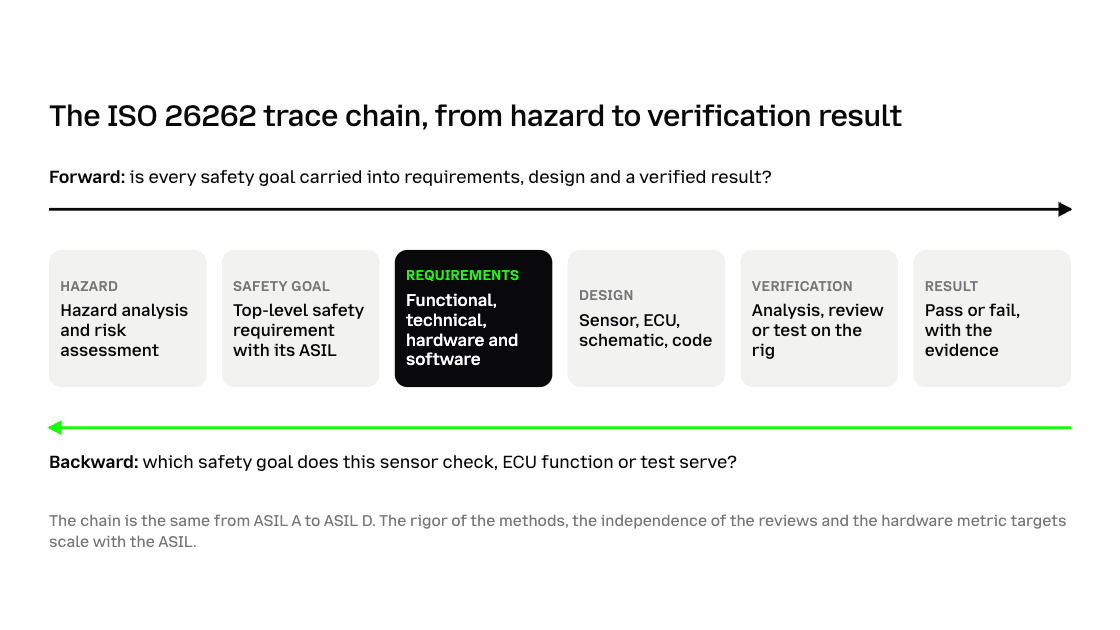
Read forward, the chain shows whether every safety goal has been carried into requirements, design and a verification result. A safety requirement with no test is a forward gap. Read backward, it shows why a sensor plausibility check, an ECU function or a test exists. A design element or a test with no safety requirement behind it is a backward gap.
The chain ends at the verification result. Owners, approvals and change history are attached to each item and are not links in the chain.
How does Automotive SPICE fit with ISO 26262?
Automotive SPICE (ASPICE) is a process assessment model published by VDA QMC, the German automotive industry’s quality management center. ISO 26262 is about the safety of the product. ASPICE rates the capability of the development process behind it, and companies usually apply the two together.
The overlap is the links. In the Automotive SPICE model, the system, hardware and software engineering processes each include a practice to ensure consistency and establish bidirectional traceability, links that can be followed in both directions, from requirements through verification measures to verification results.
The two differ in three ways:
- Scope. ISO 26262 traces the safety-related items, starting from hazards. ASPICE asks for traceability across all requirements.
- Scaling. ISO 26262 scales with the ASIL. ASPICE does not use ASILs: an assessment rates the capability level of each process.
- Consistency. ASPICE notes that traceability alone, “the existence of links”, does not mean the linked information is consistent.
For a team working to both, one set of links across all requirements can serve both.
Where does traceability break in practice?
The chain decays as the design changes:
- Requirements without tests. A hardware safety requirement is linked up to its safety goal, and no verification is ever linked to it.
- Lost rationale. The reason for a threshold or a substituted method stays in an email thread.
- Versions that drift. A test passed against an earlier version of the requirement. The link still exists, and it no longer proves anything.
- Variants traced as copies. Each vehicle variant gets its own copy of the requirement set, and the copies diverge.
Most of this is upkeep, and an AI agent can do it: it lists every safety requirement with no verification and every test with no requirement, and works out what a change touches before it is made. An engineer reviews each change, because the assessor will ask who approved it.
How Trace.Space keeps the chain current
Trace.Space is an AI-native requirements management platform for hardware teams. Requirements, design parameters, variants and tests are connected in one graph, and your team defines the item types and trace rules.
Tests trace to requirements and each test run attaches its result to the item it ran against, so a safety requirement with no test shows up as a gap in real time. Test rigs can post results through the API, as described in test management in Trace.Space.
Each test run is pinned to the version it tested, and one change shows every affected item and every test to rerun. A design parameter such as an undervoltage threshold is defined once: a changed value reaches every rolling reference, and pinned references keep their version until someone updates them.
Space Agent, the AI agent inside Trace.Space, does the upkeep described above: it suggests traces, flags broken links and coverage gaps, and answers a plain-language question about what a change would affect. Engineers review every change it proposes. Through the Trace.Space MCP (Model Context Protocol) server, the AI agents your team already uses can work with the same requirements, traces and tests. The same requirement data serves ISO 26262 and ASPICE in automotive programs.
How are vehicle variants traced?
Variants were the fourth break above. A vehicle program is a family of platforms, trim levels and regional configurations, and a safety requirement can be satisfied in one and violated in another, for example when a variant ships a different sensor or parameter value.
In Trace.Space, variants are natively built in. One set of requirements serves the whole family, and each variant pins its own versions and values. Test results are recorded per variant, so each configuration carries its own evidence against the same safety requirement, with no copies to keep in sync. See variants management.
FAQ
Does ISO 26262 require a traceability matrix?
ISO 26262 requires safety requirements to be traceable. A matrix is one way to build and check those links. In Trace.Space, teams build the matrices they need over connected items and create links in them.
Is bidirectional traceability needed at ASIL A?
Yes. ISO 26262 applies a requirement at every ASIL unless it states otherwise, and Automotive SPICE asks for bidirectional traceability whatever the ASIL.
How does ASPICE traceability differ from ISO 26262?
ISO 26262 traces safety-related items from hazard to verification result and scales the evidence with the ASIL. ASPICE asks for bidirectional traceability and consistency across all requirements and rates process capability.
See your own safety goals, requirements and test results in one connected graph. Request a free trial.
DO-178C Requirements Traceability: What Each DAL Must Show

Matt Maclaine
Nov 26, 2026
Jama Connect vs Polarion: Which Fits AI-Era Hardware Teams?
Janis Vavere
Nov 25, 2026
Robotics Requirements Management: What Physical AI Misses
Matt Maclaine
Nov 25, 2026
See Trace.Space in action
Book a demo and see how it works on your own requirements.



Built for Enterprise Engineering Teams
Want to see how Trace.Space fits into your stack?
Our team will walk you through enterprise use cases, integrations, and deployment options, tailored to your environment.